
Atomic Structure
E N D
Presentation Transcript
Atomic Structure From Indivisible to Quantum Mechanical Model of the Atom V.Montgomery & R.Smith
Classical Model • Democritus • Dalton • Thomson • Rutherford V.Montgomery & R.Smith
Democritus • Circa 400 BC • Greek philosopher • Suggested that all matter is composed of tiny, indivisible particles, called atoms V.Montgomery & R.Smith
Dalton’s Atomic Theory (1808) • All matter is made of tiny indivisible particles called atoms. • Atoms of the same element are identical. The atoms of any one element are different from those of any other element. • Atoms of different elements can combine with one another in simple whole number ratios to form compounds. • Chemical reactions occur when atoms are separated, joined, or rearranged;however, atoms of one element are not changed into atoms of another by a chemical reaction. V.Montgomery & R.Smith
J.J. Thomson (1897) • Determined the charge to mass ratio for electrons • Applied electric and magnetic fields to cathode rays • “Plum pudding” model of the atom V.Montgomery & R.Smith
Rutherford’s Gold Foil Experiment (1910) • Alpha particles (positively charged helium ions) from a radioactive source was directed toward a very thin gold foil. • A fluorescent screen was placed behind the Au foil to detect the scattering of alpha () particles. V.Montgomery & R.Smith
Rutherford’s Gold Foil Experiment (Observations) • Most of the -particles passed through the foil. • Many of the -particles deflected at various angles. • Surprisingly, a few particles were deflected back from the Au foil. V.Montgomery & R.Smith
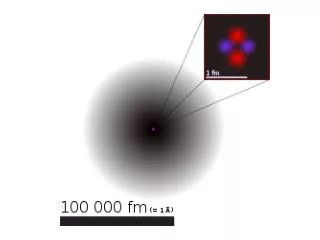
Rutherford’s Gold Foil Experiment (Conclusions) • Rutherford concluded that most of the mass of an atom is concentrated in a core, called the atomic nucleus. • The nucleus is positively charged. • Most of the volume of the atom is empty space. V.Montgomery & R.Smith
Shortfalls of Rutherford’s Model • Did not explain where the atom’s negatively charged electrons are located in the space surrounding its positively charged nucleus. • We know oppositely charged particles attract each other • What prevents the negative electrons from being drawn into the positive nucleus? V.Montgomery & R.Smith
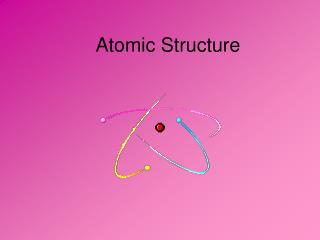
Bohr Model (1913) • Niels Bohr (1885-1962), Danish scientist working with Rutherford • Proposed that electrons must have enough energy to keep them in constant motion around the nucleus • Analogous to the motion of the planets orbiting the sun V.Montgomery & R.Smith
Planetary Model • The planets are attracted to the sun by gravitational force, they move with enough energy to remain in stable orbits around the sun. • Electrons have energy of motion that enables them to overcome the attraction for the positive nucleus V.Montgomery & R.Smith
Think about satellites…. • We launch a satellite into space with enough energy to orbit the earth • The amount of energy it is given, determines how high it will orbit • We use energy from a rocket to boost our satellite, what energy do we give electrons to boost them? V.Montgomery & R.Smith
Electronic Structure of Atom • Waves-particle duality • Photoelectric effect • Planck’s constant • Bohr model • de Broglie equation V.Montgomery & R.Smith
Radiant Energy • Radiation the emission of energy in various forms • A.K.A. Electromagnetic Radiation • Radiant Energy travels in the form of waves that have both electrical and magnetic impulses V.Montgomery & R.Smith
Electromagnetic Radiation radiation that consists of wave-like electric and magnetic fields in space, including light, microwaves, radio signals, and x-rays • Electromagnetic waves can travel through empty space, at the speed of light (c=3.00x10⁸m/s) or about 300million m/s!!! V.Montgomery & R.Smith
Waves Waves transfer energy from one place to another Think about the damage done by waves during strong hurricanes. Think about placing a tennis ball in your bath tub, if you create waves at one it, that energy is transferred to the ball at the other = bobbing Electromagnetic waves have the same characteristics as other waves V.Montgomery & R.Smith
Wave Characteristics Wavelength, (lambda) distance between successive points 2m 10m V.Montgomery & R.Smith
Wave Characteristics • Frequency, (nu) the number of complete wave cycles to pass a given point per unit of time; Cycles per second t=5 t=0 t=0 t=5 V.Montgomery & R.Smith
Units for Frequency • 1/s • s-1 • hertz, Hz • Because all electromagnetic waves travel at the speed of light, wavelength is determined by frequency • Low frequency = long wavelengths • High frequency = short wavelengths V.Montgomery & R.Smith
Waves • Amplitude maximum height of a wave V.Montgomery & R.Smith
Waves • Node points of zero amplitude V.Montgomery & R.Smith
Electromagnetic Spectrum • Radio & TV, microwaves, UV, infrared, visible light = all are examples of electromagnetic radiation (and radiant energy) • Electromagnetic spectrum: entire range of electromagnetic radiation V.Montgomery & R.Smith
Electromagnetic Spectrum Frequency Hz 1024 1020 1018 1016 1014 1012 1010 108 106 Gamma Xrays UV Microwaves FM AM IR 10-16 10-9 10-8 10-6 10-3 100 102 Wavelength m Visible Light V.Montgomery & R.Smith
Notes • Higher-frequency electromagnetic waves have higher energy than lower-frequency electromagnetic waves • All forms of electromagnetic energy interact with matter, and the ability of these different waves to penetrate matter is a measure of the energy of the waves V.Montgomery & R.Smith
What is your favorite radio station? • Radio stations are identified by their frequency in MHz. • We know all electromagnetic radiation(which includes radio waves) travel at the speed of light. • What is the wavelength of your favorite station? V.Montgomery & R.Smith
Velocity of a Wave • Velocity of a wave (m/s) = wavelength (m) x frequency (1/s) • c = • c= speed of light = 3.00x10⁸ m/s • My favorite radio station is 105.9 Jamming Oldies!!! • What is the wavelength of this FM station? V.Montgomery & R.Smith
Wavelength of FM • c = • c= speed of light = 3.00x10⁸ m/s • = 105.9MHz or 1.059x10⁸Hz • = c/ =3.00x10⁸ m/s = 2.83m 1.059x1081/s V.Montgomery & R.Smith
What does the electromagnetic spectrum have to do with electrons? • It’s all related to energy – energy of motion(of electrons) and energy of light V.Montgomery & R.Smith
States of Electrons • When current is passed through a gas at a low pressure, the potential energy (energy due to position) of some of the gas atoms increases. • Ground State: the lowest energy state of an atom • Excited State: a state in which the atom has a higher potential energy than it had in its ground state V.Montgomery & R.Smith
Neon Signs • When an excited atom returns to its ground state it gives off the energy it gained in the form of electromagnetic radiation! • The glow of neon signs,is an example of this process V.Montgomery & R.Smith
White Light • White light is composed of all of the colors of the spectrum = ROY G BIV • When white light is passed through a prism, the light is separated into a spectrum, of all the colors • What are rainbows? V.Montgomery & R.Smith
Line-emission Spectrum • When an electric current is passed through a vacuum tube containing H2 gas at low pressure, and emission of a pinkish glow is observed. • What do you think happens when that pink glow is passed through a prism? V.Montgomery & R.Smith
Hydrogen’s Emission Spectrum • The pink light consisted of just a few specific frequencies, not the whole range of colors as with white light • Scientists had expected to see a continuous range of frequencies of electromagnetic radiation, because the hydrogen atoms were excited by whatever amount of energy was added to them. • Lead to a new theory of the atom V.Montgomery & R.Smith
Bohr’s Model of Hydrogen Atom • Hydrogen did not produce a continuous spectrum • New model was needed: • Electrons can circle the nucleus only in allowed paths or orbits • When an e- is in one of these orbits, the atom has a fixed, definite energy • e- and hydrogen atom are in its lowest energy state when it is in the orbit closest to the nucleus V.Montgomery & R.Smith
Bohr Model Continued… • Orbits are separated by empty space, where e- cannot exist • Energy of e- increases as it moves to orbits farther and farther from the nucleus (Similar to a person climbing a ladder) V.Montgomery & R.Smith
Bohr Model and Hydrogen Spectrum • While in orbit, e- can neither gain or lose energy • But, e- can gain energy equal to the difference between higher and lower orbitals, and therefore move to the higher orbital (Absorption) • When e- falls from higher state to lower state, energy is emitted (Emission) V.Montgomery & R.Smith
Bohr’s Calculations • Based on the wavelengths of hydrogen’s line-emission spectrum, Bohr calculated the energies that an e- would have in the allowed energy levels for the hydrogen atom V.Montgomery & R.Smith
Photoelectric Effect • An observed phenomenon, early 1900s • When light was shone on a metal, electrons were emitted from that metal • Light was known to be a form of energy, capable of knocking loose an electron from a metal • Therefore, light of any frequency could supply enough energy to eject an electron. V.Montgomery & R.Smith
Photoelectric Effect pg. 93 • Light strikes the surface of a metal (cathode), and e- are ejected. • These ejected e- move from the cathode to the anode, and current flows in the cell. • A minimum frequency of light is used. If the frequency is above the minimum and the intensity of the light is increased, more e- are ejected. V.Montgomery & R.Smith
Photoelectric Effect • Observed: For a given metal, no electrons were emitted if the light’s frequency was below a certain minimum, no matter how long the light was shone • Why does the light have to be of a minimum frequency? V.Montgomery & R.Smith
Explanation…. • Max Planck studied the emission of light by hot objects • Proposed: objects emit energy in small, specific amounts = quanta (Differs from wave theory which would say objects emit electromagnetic radiation continuously) Quantum: is the minimum quantity of energy that can be lost or gained by an atom. V.Montgomery & R.Smith
Planck’s Equation • E radiation = Planck’s constant x frequency of radiation • E = h • h = Planck’s constant = 6.626 x 10⁻³⁴ J•s • When an object emits radiation, there must be a minimum quantity of energy that can be emitted at any given time. V.Montgomery & R.Smith
Einstein Expands Planck’s Theory • Theorized that electromagnetic radiation had a dual wave-particle nature! • Behaves like waves and particles • Think of light as particles that each carry one quantum of energy = photons V.Montgomery & R.Smith
Photons • Photons: a particle of electromagnetic radiation having zero mass and carrying a quantum of energy • Ephoton = h V.Montgomery & R.Smith
Back to Photoelectric Effect • Einstein concluded: • Electromagnetic radiation is absorbed by matter only in whole numbers of photons • In order for an e- to be ejected, the e- must be struck by a single photon with minimum frequency V.Montgomery & R.Smith
Example of Planck’s Equation • CD players use lasers that emit red light with a of 685 nm. Calculate the energy of one photon. • Different metals require different minimum frequencies to exhibit photoelectric effect V.Montgomery & R.Smith
Answer • Ephoton = h • h = Planck’s constant = 6.626 x 10⁻³⁴ J•s • c = • c= speed of light = 3.00x10⁸ m/s • = (3.00x10⁸ m/s)/(6.85x10-7m) • =4.37x10141/s • Ephoton= (6.626 x 10⁻³⁴ J•s)(4.37x10141/s) Ephoton= 2.90 x 10⁻¹⁹J V.Montgomery & R.Smith
Wave Nature of Electrons • We know electrons behave as particles • In 1925, Louis de Broglie suggested that electrons might also display wave properties V.Montgomery & R.Smith
de Broglie’s Equation • A free e- of mass (m) moving with a velocity (v) should have an associated wavelength: = h/mv • Linked particle properties (m and v) with a wave property () V.Montgomery & R.Smith