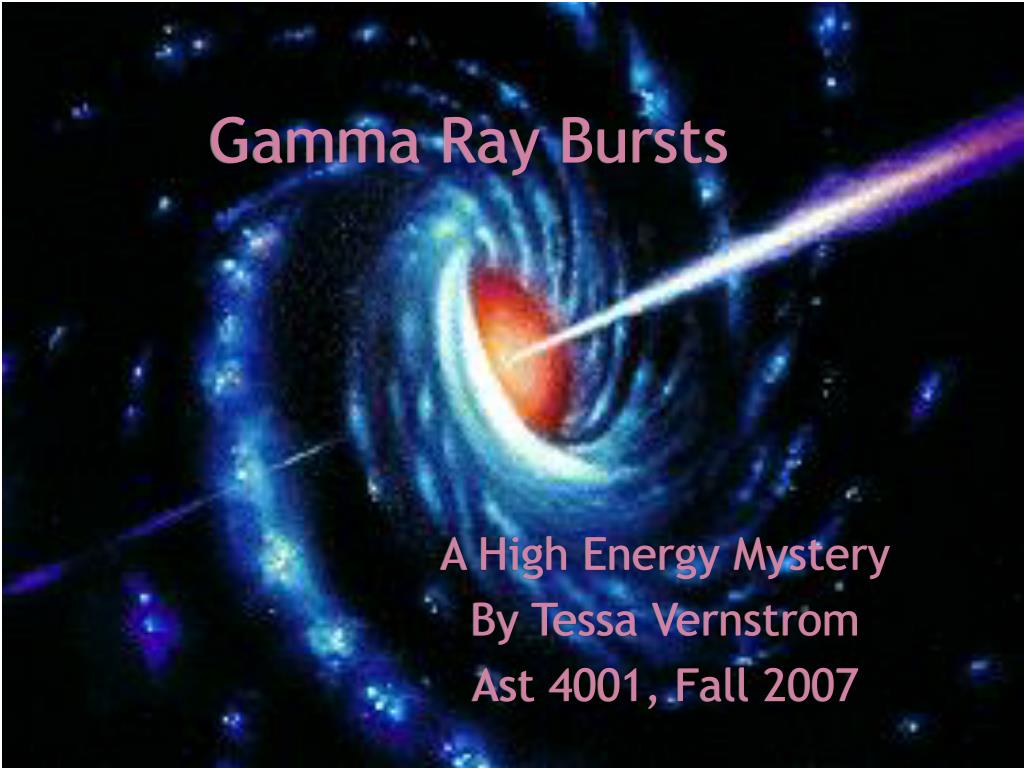
Gamma Ray Bursts A High Energy Mystery By Tessa Vernstrom Ast 4001, Fall 2007
Briefly: What are They? Gamma Ray Bursts, or GRBs, are short lived bursts of high energy gamma photons. They have wavelengths ranging from .03nm to .003nm.There are two different categories of GRBs: long duration and short duration. It is believed these different types come from different sources.
Discovery GRBs were discovered by the US Vela Nuclear Test Detection Satellites in the 1960s. These were built to detect gamma rays coming from nuclear weapon tests in space. The satellites did detect flashes of radiation that were not from nuclear explosions seeming to come from random directions in space. As recent as the 1990’s scientists didn’t know where these flashes were coming from or what was causing them .
Long Duration Bursts Last anywhere from 2 seconds to a few hundred seconds, the average is about 30 seconds. Come from stars billions of light years away. Evenly distributed all over the sky. Believed to come from a hypernova, and Wolf-Rayet stars.
They can vary greatly in duration, counts per • second, and other properties.
Wolf-Rayet Stars Mass at least 20 solar Masses Temperature around 45,000 degrees Fahrenheit. Expel heated gas in bursts and have very strong winds. Very short life spans, typically about a few million years. During its death throws can undergo uneven gravitational collapse, causing gamma rays bursts. Turns into a black hole. Example is Eta Carinea
Hypernova • The death of a super massive star • Has mass 50 to 150 solar masses • The core of the hypernova collapses directly into a black hole and two extremely energetic jets of plasma are emitted from its rotational poles at nearly the speed of light. These jets emit intense gamma rays, and are a candidate explanation for gamma ray bursts. • About 1 out of every 100 supernova is a hypernova
Here are some animations to illustrate these points • 1 • 2 • 3
After Glow • The emission of the jets from the collapsing star excite nearby gas and dust. • This gives off photons and allows us to see the phenomenon in other wavelengths such as x-rays, visible light, and radio waves. • Afterglow can last for days or weeks. • Gives credence to the super or “hyper” nova hypothesis.
Short GRBs • A GRB lasting less than 2 seconds, with an average of 300 milliseconds. • Significantly dimmer than long GRBs and have higher energies. • Explanation not as well understood. Several possible explanations. • Until recently were “dark” GRBs, not giving off a detectable afterglow.
Short GRBs Cont • Scientists think it could come from the collisions of two very dense objects, such as neutron stars in a binary. • Also, some think, they could be from the same process as the long GRB but were not directly along the axis of the emission, i.e. not seeing it face on.
Why Study Them • Tells us about the evolution/death of high mass star or exotic stars. • Tells us about the early universe • Because so much is still unknown may discover new stellar properties • Mass extinctions
Still To know • The means by which gamma-ray bursts convert energy into radiation remains poorly understood, and as of 2007 there is still no generally accepted model for how this process occurs. • A successful model of GRBs must explain not only the energy source, but also the physical process for generating an emission of gamma rays which matches the durations, light spectra, and other characteristics of observed GRBs.
References • http://imagine.gsfc.nasa.gov/docs/science/know_l1/bursts.html • http://en.wikipedia.org/wiki/Gamma_ray_burst • http://www.astro.psu.edu/users/nnp/grbphys.html • http://grb.sonoma.edu/ • http://science.hq.nasa.gov/kids/imagers/ems/gamma.html • http://cfa-www.harvard.edu/~pberlind/atlas/htmls/wrstars.html • Kouveliotou, C. et al. (1993). "Identification of two classes of gamma-ray bursts". Astrophysical Journal413: L101 • Sari,Re'em; Piran,Tsvi; Halpern,JP. ”Jets in Gamma Ray Bursts”.Astrophysical Journal, Volume 519, Issue 1, pp. L17-L20.