

SlideServe
Menu
Préférences
© SlideServe · v2026

Gamma-ray bursts

norris avatar
19 diapositives · 440 Views · Aug 26, 2014

Gamma-ray bursts. Discovered in 1968 by Vela spy satellites Occur ~ 3 times a day at random positions in the sky. Variability on a less than 1 ms timescale – must be a very small object. Compton gamma-ray observatory discovered two puzzles:. GRBs are distributed isotropically on the sky
Gamma-ray bursts - slide 1
01 / 19Gamma-ray bursts
1 / 17

Télécharger la présentation

Gamma-ray bursts
Une image / un lien ci-dessous est fourni (tel quel) pour télécharger la présentation

Politique de téléchargement : le contenu du site vous est fourni TEL QUEL pour votre information et votre usage personnel ; il ne peut être vendu, concédé sous licence ni partagé sur d’autres sites sans l’accord de son auteur.Le contenu vous est fourni TEL QUEL, pour votre information et votre usage personnel uniquement. Téléchargez la présentation en cliquant sur ce lien. Lors du téléchargement, si vous ne parvenez pas à télécharger une présentation, l’éditeur a peut-être supprimé le fichier de son serveur.Pendant le téléchargement, si vous ne parvenez pas à obtenir une présentation, le fichier a peut-être été supprimé par l’éditeur.

F I N

Plus de contenu associé

Transcription de la présentation
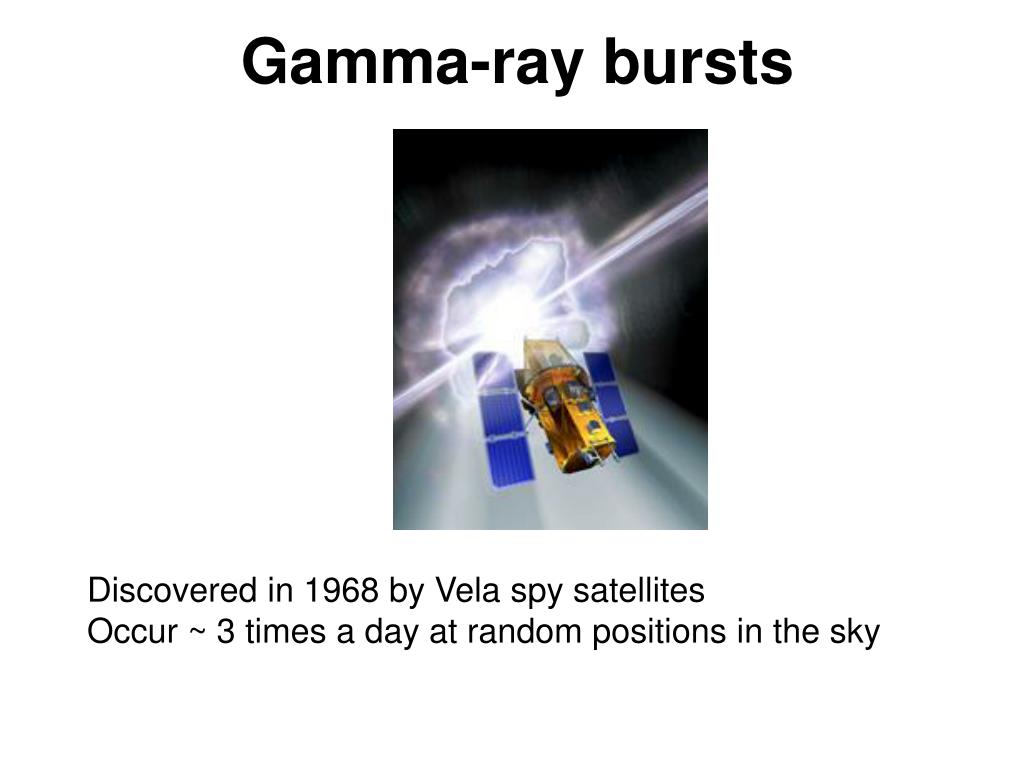
  1. Gamma-ray bursts Discovered in 1968 by Vela spy satellites Occur ~ 3 times a day at random positions in the sky

  2. Variability on a less than 1 ms timescale – must be a very small object

  3. Compton gamma-ray observatory discovered two puzzles: • GRBs are distributed isotropically on the sky • There is a deficiency of weak bursts – are we looking over the edge of their distribution?

  4. GRB distribution Gamma-ray sky

  5. GRB duration: bimodal distribution 20% of GRBs last less than 2 s with a peak at 0.4 s 80% of GRBs last more gthan 2 s with a peak at 40 s

  6. Red: long-duration, bright bursts Purple: short-duration, dim bursts

  7. Breakthrough: in 1997 when BeppoSAX satellite was able to detect the burst position at 1 arcmin resolution and coordinate with optical telescopes within 1 hour after the burst An X-ray image of the gamma-ray burst GRB 970228, obtained by the team of Italian and Dutch scientists at 5:00 AM on Friday 28th February, 1997, using the BeppoSAX satellite.

  8. Discovery of the optical and radio counterparts of GRBs Spectral lines with redshift from 0.8 to over 6! • GRBs are at the edge of the observable universe • They must be the most powerful explosions in the • universe: ~ 1 solar mass is converted into gamma-rays • in a few seconds!

  9. Gamma-ray burst models Theory #1: a peculiar supernova (hypernova) A hypernova model for long-duration bursts seems to be more or less successful. A Wolf-Rayet star undergoing core collapse into a black hole WR star: a very hot, massive, erratic star with sporadic outbursts In the collapse, a blast wave propagates from the core outwards. When the star is rotating, the collapse is asymmetric. Hot gamma rays and ee+ plasma escape along the narrow cone parallel to the rotation axis. Erratic structure of the GRB is produced by shock waves propagating through the expelled material along the cone. We can see the burst only if the axis points at the Earth. A much slower expansion of the outer shell causes a usual supernova-type light curve and is usually invisible. An afterglow at lower photon energies is produced when hot relativistic plasma starts coasting in the interstellar medium.

  10. Evidence? 1. long gamma-ray bursts are found without exception in systems with abundant recent star formation, such as in irregular galaxies and in the arms of spiral galaxies. 2. A tentative link between GRB 980425 in 1998 and a supernova 1998bw 3. GRB 030329 on March 29, 2003, with an optical spectrum of an afterglow resembling a supernova

  11. Red giant: gore collapses and gets hotter, while the envelope expands and cools down

  12. Known types of supernovae Type II: hydrogen lines; collapse of a massive star Type I: no hydrogen lines Fig. 10-18, p. 202

  13. Type Ia supernova Fig. 10-12, p. 197

  14. Hard to imagine a supernova without ejection of a star shell

  15. Models for short-duration GRBs Much shorter, dimmer, almost no afterglow, harder spectra Very few are associated with galactic hosts (??!) Mechanism is different from a collapsar/hypernova

  16. Colliding neutron stars