Industrial revolution
This chapter explores the Industrial Revolution, highlighting its defining features and key factors of success. It delves into the Enclosure Movement and the "Factors of Production," analyzing how land, labor, and capital contributed to massive industrial growth. It discusses the impacts on society, including labor conditions, urbanization, and the rise of labor unions. Furthermore, it examines the ideas of laissez-faire economics and key figures like Adam Smith and Andrew Carnegie. The chapter also reflects on technological innovations and their profound effects on 19th-century society.


Industrial revolution
E N D
Presentation Transcript
Industrial revolution Chapter 21
Turn to page 633 – complete on blank paper • Define Industrial Revolution • List and Explain the Factors of Success • Define and draw an example of the Enclosure Movement • Finish the “Factors of Production” Graphic Organizer:
Industrial Revolution: era moving to power-driven machines – started in GB
Factors for Great Britain’s Success 1. Exploration & Colonialism: raw materials! 2. Sea power: transportation 3. Political Stability: country was at peace 4. Government Support: Parliament helped compete 5. Growth of Private Investment: “research & development”
Spreads to the West: Personal freedom = competition “Life Liberty and the Pursuit of Happiness” takes on a new meaning
Industrial Revolution • Factors of Production: • 1. Land – natural resources • 2. Labor – workers • 3. Capital: funds for investments in business
Factories & Mass Production • Mass Production: manufacturing large numbers of identical items • Interchangeable Parts: identical machine-made parts • Assembly Lines: product moves from worker to worker SPEEDS UP PRODUCTION = MORE PRODUCTION
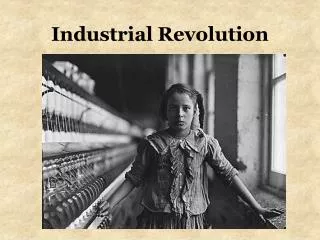
Turn to Pages 642-643 • View images and captions • 1. What was life like in a factory • 2. What dangers were there – • What kind of injuries do you think children could get • 3. How was a factory organized (use smaller image) • 4. Why do you think many factories were on the water • Based on the images
WITH YOUR GROUP: • DISCUSS: How will the Industrial Revolution affect society? • CITIES V COUNTRY • FAMILIES • SOCIAL CLASSES • POLITICS • ECONOMICS • COUNTRIES AS WHOLES • SECRETARY: take notes on what your group mates decide
Increase in STANDARD OF LIVING – level of material comfort…Leisure Time
New Ideas in a New Society • Laissez-Faire Economics • “Free to Do,” Hands Off! • Adam Smith The Wealth of Nations • No government interference • Businesses can compete freely against each other • Smith’s ideas ended regulations by 1840s • Entrepreneur: Someone who starts a new business
Andrew Carnegie • Born in Scotland • Rags to Riches! • Steel Tycoon • “Vertical Integration” • Owning each step • Monopolies • Donated all his wealth
Socialism/Communism • Robert Owen • Socialism: • For the good of all, society/government should own property and control industry • Karl Marx • Communism: radial socialism • As capitalism grew, more workers would sink into poverty • The poor will rebel, and seize the “means of production” and govern themselves • Das Kapital: the evils of capitalism
Effects on Society • New Economic Ideas • Shift from Cottage Industries affected roles of women “separate spheres” • Great Britain, France, Germany become global economic leaders • USA industrialized rapidly, and gains global political power!
New Inventions • Steamships – long distance travel by 1870 • Telegraph- Samuel Morse, 1837 • Telephone – Alexander Graham Bell, 1876 • Light bulb – Thomas Edison, 1879 • Automobile – Henry Ford, 1908 • Airplane- Wright Brothers, 1903
Type II • What effect on society do I think was the greatest? • Which invention do I think had the greatest effect on society?
Document Based Questions • Pages 652-533 • Questions 1-4 • Pages 677 • Questions 1-2