Understanding Basic Statistical Concepts: From Variability to Hypotheses and ANOVA
This review covers essential statistical concepts crucial for data analysis, including measures of variability, distributions, and hypothesis testing. It explains key statistical tests, such as T-tests and ANOVA (both one-way and two-way), and emphasizes the importance of understanding error types. Through practical examples, the text illustrates how to report statistical findings, such as means and standard errors, and the implications of normal and Poisson distributions. By grasping these foundational ideas, you will enhance your ability to analyze and interpret data effectively.

Understanding Basic Statistical Concepts: From Variability to Hypotheses and ANOVA
E N D
Presentation Transcript
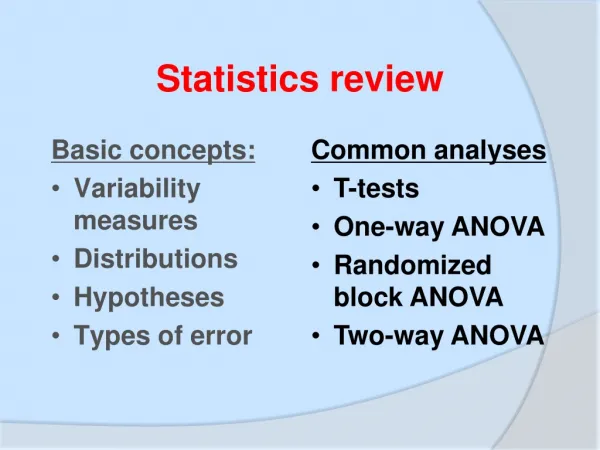
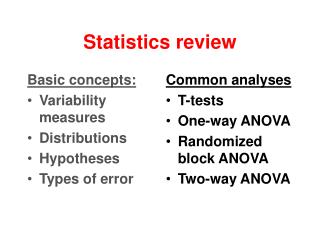
Statistics review Basic concepts: • Variability measures • Distributions • Hypotheses • Types of error • Common analyses • T-tests • One-way ANOVA • Two-way ANOVA • Regression
Variance • S2= Σ (xi – x )2 • n-1 x
S2= Σ (xi – x )2 • n-1 Variance What is the variance of 4, 3, 3, 2 ? 2/3
Variance variants 1. Standard deviation (s, or SD) = Square root (variance) Advantage: units
Variance variants 2. Standard error (S.E.) = s n Advantage: indicates reliability
How to report • We observed 29.7 (+ 5.3) grizzly bears per month (mean + S.E.). • A mean (+ SD)of 29.7 (+ 7.4) grizzly bears were seen per month + 1SE or SD - 1SE or SD
Distributions Normal • Quantitative data Poisson • Count (frequency) data
Normal distribution 67% of data within 1 SD of mean 95% of data within 2 SD of mean
Poisson distribution mean Mostly, nothing happens (lots of zeros)
Poisson distribution • Frequency data • Lots of zero (or minimum value) data • Variance increases with the mean
What do you do with Poisson data? • Correct for correlation between mean and variance by log-transforming y (but log (0) is undefined!!) • Use non-parametric statistics (but low power) • Use a “general linear model” specifying a Poisson distribution
Hypotheses • Null (Ho): no effect of our experimental treatment, “status quo” • Alternative (Ha): there is an effect
Hypotheses Null (Ho) and alternative (Ha): always mutually exclusive So if Ha is treatment>control…
Whose null hypothesis? Conditions very strict for rejecting Ho, whereas accepting Ho is easy (just a matter of not finding grounds to reject it). A criminal trial? Environmental protection? Industrial viability? Exotic plant species? WTO?
Types of error Reject Ho Accept Ho Ho true Ho false
Types of error • Usually ensure only 5% chance of type 1 error (ie. Alpha =0.05) • Ability to minimize type 2 error: called power
Statistical tests All ask: does rejecting Ho help explain some of the variance in the world? NO YES Categorical treatments A B Ho DATA Continuous treatments A B
The t-test Asks: do two samples come from different populations? YES NO DATA Ho A B
The t-test Depends on whether the difference between samples is much greater than difference within sample. A B Between >> within… A B
sp2 + sp2 n1 n2 The t-test T-statistic= Difference between means Standard error within each sample
sp2 + sp2 n1 n2 The t-test How many degrees of freedom? (n1-1) + (n2-1)
The t-test Can also compare a sample to an expected value: Ho Ha DATA • What is the formula?
T-tables Two samples, each n=3, with t-statistic of 2.50: significantly different?
If you have two samples with similar n and S.E., why do you know instantly that they are not significantly different if their error bars overlap?