Understanding Continuous and Discrete Variables: Probability Distributions and Measures of Central Tendency
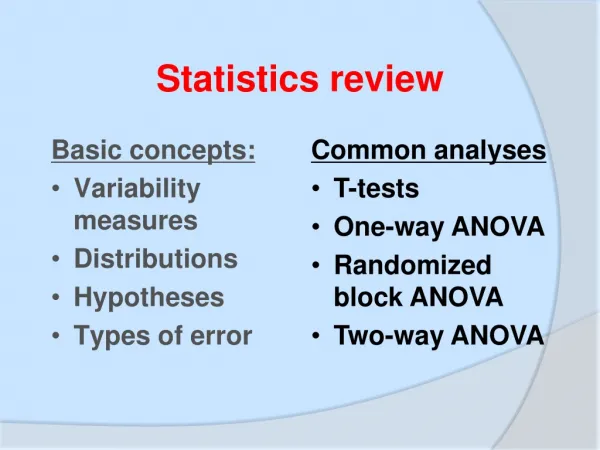
This guide explores continuous and discrete variables, focusing on probability and frequency distributions. It discusses the three measures of central tendency: mean, median, and mode, emphasizing their relation in symmetrical distributions. We will calculate the mean and measure spread through variance and standard deviation using both actual and grouped data. The analysis will include contingency tables for categorical data and bivariate data relationships. Additionally, standard discrete and continuous distributions will be introduced, including binomial and normal distribution functions.

Understanding Continuous and Discrete Variables: Probability Distributions and Measures of Central Tendency
E N D
Presentation Transcript
Statistics Review Discrete Variables
Three Measures of Central Tendency * Note that when distributions are symmetrical, the mean, the median and the mode will all be the same value.
Variance and Standard Deviation using actual data.
Variance and Standard Deviation using grouped data. • The actual data gives the “true values of mean and variance. • But, especially for large samples, grouped data is a good approximation.
We have already looked at bivariate categorical data in the context of descriptive bivariate distributions …..
Contingency Tables represent the association between two or more qualitative or categorical variables. Example of females in San Francisco:
In this class, we will … • Re-examine bivariate data that are related to one another in a causal way. • Introduce standard discrete and continuous distribution/density functions (the binomial and normal distribution functions, respectively). • Analyze and characterize bivariate data that are characterized by these standard distributions.