Exciting Aspects of Viking Life: Sports, Travel, and Legacy in History
The Vikings led fascinating lives filled with fun and excitement beyond their battles and farming. They engaged in various competitions, including sword fights, weight-lifting, and even chicken chases. Contrary to popular belief, Vikings were not just tall warriors with horned helmets; they wore practical clothing suited for their cold environments. Their iconic longships enabled them to explore and raid with speed and agility. The Viking Age left a lasting legacy, influencing language and culture in Britain, with many words originating from their Norse traditions.

Exciting Aspects of Viking Life: Sports, Travel, and Legacy in History
E N D
Presentation Transcript
bySam Clayton Viking Facts
What did the Vikings do for fun ? All sorts of things. When they weren't fighting , farming , hunting or house keeping , they were enjoying themselves. They didn’t have organized sports as we do, but if they got together for a special occasion , they often challenged each other to fights and competitions.
What sorts of competitions did they have ? Anything they were good at. Some of the different sports they played were Swordfights, Weight-lifting, Chasing Chickens and Wrestling.
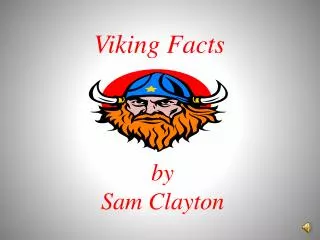
What did Vikings look like ? People often imagine Vikings as tall and fierce- looking , with long red beards and helmets with wings or horns. In fact some Vikings may have been quite small, and their helmets were plain, with no horns.
What clothes did they wear ? Really warm ones. It was pretty cold most of the time. The women wore long dresses and the men wore trousers and tunics. These were usually made of wool or linen. They had thick cloaks of wool or fur.
How Did the Vikings Get Around? Vikings used longships which were fast and sleek, They were powered by sail or oars and they were ideally suited for raiding. Shipbuilders took pride in building beautiful ships and usually decorated the front with a fierce looking carving. The longboat was built to survive the stormy seas and to sail on shallow rivers. They were also built light enough to be carried over land. When the wind was behind a longboat, the Vikings used large sails. If there wasn't any wind, or it was blowing in the wrong direction, up to 80 warriors could use oars to power the boat.
What Happened to the Vikings? Throughout the Viking Age, there were many battles between the Vikings and the English. In the 9th century, the English king Alfred the Great stopped the Vikings taking over all of England. In the 10th century the English reconquered much of the land held by Vikings. In 954, they drove out Eric Bloodaxe, the last Viking king of Jorvik. After Eric was killed in battle, the Vikings in England agreed to be ruled by England's king.
What the Vikings Left Behind Archaeologists find the remains of Viking houses, burial sites, treasure hoards, carvings on stones, and writing carved in runes. Vikings left their mark on Britain in other ways too, such as language, Lots of familiar English words originally came from the Vikings' Norse language. Examples are 'husband', 'egg', 'law' and 'knife'. Place names show where Vikings once lived. The Vikings also left behind many stories about real people, called 'sagas'. Scotland has its own saga from the Viking Age, called 'Orkneyinga Saga' or 'The History of the Earls of Orkney'.
For further in formation on Vikings click on the links below http://www.ydalir.co.uk/gallery/2006/lindisfarne.htm http://www.britishmuseum.org/explore/online_tours/europe/the_vikings/the_vikings.aspx http://wayback.archive-it.org/1961/20100805084246/http://www.ltscotland.org.uk/5to14/resources/illustrations/celtspictsandvikings/index.asp http://www.britishmuseum.org/explore/online_tours/britain/our_top_ten_british_treasures/the_lewis_chessmen.aspx http://www.mnh.si.edu/vikings/learning/boardgame.html http://www.bbc.co.uk/cbbc/horriblehistories/getthelook/