
Purpose
E N D
Presentation Transcript
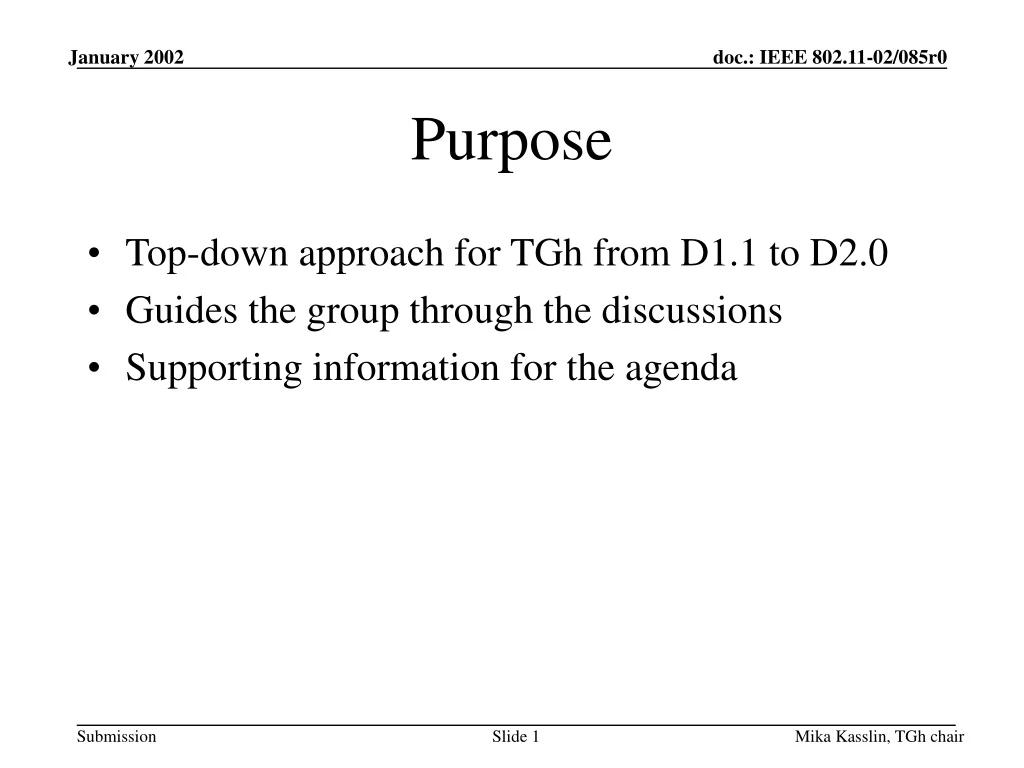
Purpose • Top-down approach for TGh from D1.1 to D2.0 • Guides the group through the discussions • Supporting information for the agenda Mika Kasslin, TGh chair
TPC Topics TPC.1) Power Constraint element (7.3.2.16) • New format proposed in 01/664r0 TPC.2) Power Capability element (7.3.2.17) • New format proposed in 01/664r0 TPC.3) TPC Report element (7.3.2.19) • Transmit Power field syntax TPC.4) Tolerances • Transmit power • Measurements, link margin TPC.5) TPC procedures (9.11) TPC.6) New definitions • transmit power • receiver power Mika Kasslin, TGh chair
General Topics GEN.1) Action Frame definition • New format proposed in 01/665r0 • Defined in 7.2.3.12 and used in 7.4 of 01/664r0 GEN.2) Reason Code • Changes proposed in 7.3.1.7 of 01/664r0 GEN.3) Status Code • Changes proposed in 7.3.1.9 of 01/664r0 GEN.4) New channels (5470-5725 MHz) listed GEN.5) PICS • skeleton in 01/664r0 GEN.6) MIB • proposal in 01/533r0 and 01/664r0 Mika Kasslin, TGh chair
DFS Topics DFS.1) Channel Switch Announcement element • Re-edit in 01/664r0 DFS.2) Use of containers • Discussed in Austin • Defined and used in 01/664r0 (frame -> element -> container) DFS.3) IBSS • Proposal in 01/532r0 DFS.4) BSS • Mechanism and reports in D1.1 DFS.5) DFS procedures • Text proposal in 01/664r0 Mika Kasslin, TGh chair
DFS Framework Issues Start-up phase: • start-up test period (no less than 30 seconds) • How about upper limit? • start-up phase rate Normal operation: • periodicity of quiet periods to listen radar signals • Tailored for HL/2 with 2 ms frames • Amount of quiet periods (20%) • channel switch time (6 ms) Common: • response time (100 ns) Ideas: • more heuristic methods taking into account radar characteristics • frequency range • periodicity Mika Kasslin, TGh chair