
Vertebrates
E N D
Presentation Transcript
Phylum Chordata 4 basic characteristics: • Notochord – supporting rod dorsally located, below the nerve cord, replaced by vertebral column in most chordates • Nerve cord – anterior portion becomes brain, rest spinal cord • Pharyngeal pouches – only seen during embryonic development, gills in aquatic vertebrates. In humans, 1st pair = auditory tubes, 2nd = tonsils, 3 and 4th pair = thyroid and parathyroid • Postanal tail – in embryo if not in adult
Nonvertebrate chordates • Notochord persists in adults • Lancelets • marine, few centimeters long • retain 4 chordate characteristics as adult • Sea squirts (tunicates) • live on ocean floor • squirt water in defense • Retain gills as adult
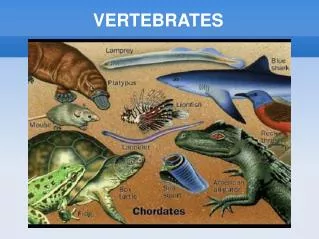
Vertebrates • At some stage in life history, have all four chordate characteristics • Living endoskeleton with vertebral column • Closed circulatory system • Paired appendages • Efficient respiration and excretory • High degree of cephalization
Fishes • Evolution • Jawless – agnathans, lamprey • jaws • Cartilaginous – sharks, stingrays • Bony - • Lobe finned – coelacanths, thought to give rise to amphibians • Ray finned – soldier fish, lionfish, seahorse, swordfish
Fish Characteristics • Aquatic ectotherms – depend on environment to regulate body temp • Skin covered with scales • Fins for swimming • Single loop cardiovascular pathway, 2 chambered heart • Breath with gills • Lay eggs • Swim bladder seen in bony fish, buoyancy
Amphibians • Live on both land and water • 3 main groups • Salamanders and newts –elongated bodies, long tails • Frogs and toads - tailless • Caecilians – legless, sometimes sightless, worm shaped
Amphibian characteristics • Usually tetrapod – 4 legged • Usually lungs in adults • Metamorphosis • Smooth and moist skin • 3 chambered heart • Ectothermy • Most lay eggs in water
Reptiles • Amniotic egg evolves • Extraembryonic membranes – protect the embryo, remove nitrogenous wastes and provide the embryo with oxygen, food and water • Crocodiles and alligators, turtles, lizards, snakes, amphisbaenians (worm lizards) and tuataras
Reptile characteristics • Usually tetrapods • Lungs with expandable rib cage • Leathery-sheledamniotic egg – allows for movement to land • Dry, scaly skin that is impermeable to water • Ectotherms – can lay in sun to maintain a warm body temperature
Birds - Aves • Some fly, some do not • Usually classified according to beak and foot type • Efficient nervous, respiratory, and circulatory systems.
Bird characteristics • Feathers • Hard shelled amniotic egg • 4 chambered heart • Usually wings for flying • Air sac • endothermy
Mammals - development • Monotremes – mammals have a cloaca and lay hard shelled amniote eggs • Duckbill platypus and spiny anteater • Marsupials – begin development inside the female body and born in a very immature condition, move to pouch and attach to nipple • Kangaroo, koala, wombat • Placental mammals – Eutherians - dependent on the placenta (organ of exchange between maternal blood and fetal blood) • Long dependency on the parents
Mammal characteristics • Body hair • Differentiated teeth • Well-developed brain • Usually live births and newborn dependency • Mammary glands • Endothermy • Internal development