Download
1 / 13
130 likes | 268 Vues
This presentation by Tivadar Szemethy from Vanderbilt University explores a model-based design platform that enables efficient interaction and analysis of system components based on a 'Model of Computation' (MoC). It emphasizes runtime platform abstraction of hardware, software, and middleware services. The methodology includes system synthesis, verification of design requirements, and formal analysis utilizing various modeling languages like UPPAAL and SMV. The presentation also discusses the generation of analysis models and the importance of a well-defined toolchain for successful transformations between component design and implementation.

E N D
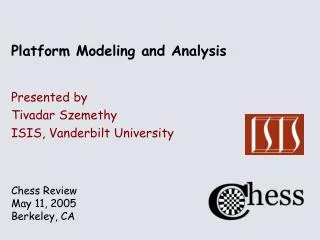
Platform Modeling and Analysis Presented by Tivadar Szemethy ISIS, Vanderbilt University
Model-Based Design with Components Design Model components interacting according to a “Model of Computation” Runtime Platform abstraction of HW/SW/MW services Component-Based System • System Synthesis: • Map the design-time components into platform objects • Enforce interaction rules using platform services
Analysis model for verification • Verification: • does it satisfy requirements specification ? • Need design requirements, in terms of • observable MoC events (mapped to Platform) • Platform quantities (resources) Behavior := System Model + Components + MoC semantics + Platform properties Analysis necessitates Platform-level model
Platform-level analysis model • Purpose • formal verification (ideal) • simulation (at least) • Language for analysis model: • SMV/SPIN model, Timed/Hybrid Automata… • Simulink… • To be automatically constructed based on • MoC semantics (formal, well-defined) • Platform properties (?)
Example: SMOLES -> UPPAAL 1. • Application: Camera tracking an object • Simple MOdeling Lang. for Embedded Sys. • Dataflow-oriented DSML in GME • Components, Ports, Triggers, Timers, Methods • Platform: DataFlow Kernel • simple OO asynch. dataflow engine in C++/Java • SMOLES model interpreter generates code • Analysis model: UPPAAL Timed Automata
. . Example: SMOLES -> UPPAAL 3. inv: IdleClk<IdlePeriod g: (running == kernel && Timer1Clk > Period1 && Timer1OutBuff.avaliable()) u: Timer1Clk.reset() Kernel idle runTimer1 u: Timer1OutBuf++ . . . Componenti schedule g: (running == kernel && UComp1.Methodm.Triggert) u: running:=Comp1 runComponent1 g: running == kernel g: (running == me && trigger1 == true) u: input_token_cnt-- g: IdleClk >= IdlePeriod Method1 . inv: (clk < WCET) g: (running == kernel && not(UCompn.Methodm.Triggert) && not(UTimernClk>Periodn) u: IdleClk.reset() g: (clk >= BCET) u: output_token_cnt++, running:=Kernel Idle Methodn
Example: SMOLES -> UPPAAL 4. Translation ruleset input: SMOLES model output: UPPAAL TA implicit: DFK “internals” Platform-level model one TA per component one TA for Kernel • Translation using • graph transformations • GReAT graph rewriting tool (GME add-on)
UPPAAL analysis model too restrictive no preemptive scheduling only for timing analysis no higher-level structures “Intermediate format” e.g. IF or Metropolis higher-level language provides mapping to multiple analysis tools DFK model was implicit in transformation: complex, monolithic transformation spec. Platform model as “Skeleton” for Components Kernel Rules to construct synchronizers/guards Composition Lessons learned results published in: “Platform Modeling and Model Transformations for Analysis” in Journal of Universal Computer Science vol. 10, pp. 1383-1407, 2004
Generating the analysis model • The DSML → IF transformation needs to “know”: • DSML → Platform mapping • Platform →IF mapping • Platform interaction rules Well-defined toolchain
Generating the transformation • Encoded in the transformation: • DSML to Platform mapping • Platform to IF (“expansion”) • Platform interaction rules • Transformation generator: • rewrite the (DSML→Platform) • mapping to (DSML →IF) • model composition rules • (through Kernel entity, • defined in the PM) Well-defined toolchain
The “Big Picture” Meta- level “operational” level
Preliminary results • Formalizing the Platform • GME metamodel for DFK • SMOLES → DFK transformation specified as graph transformation in GReAT • In search of an Intermediate Format • Evaluating VERIMAG’s IF framework (metamodel, simple translators and examples) • Started working on modeling • Giotto with E-machine