Structured Approaches to Product Design and Development: Insights from Ulrich and Eppinger
This chapter introduces structured methods for product design and development, focusing on key techniques like functional decomposition and set-based design. It aims to equip readers with the skills to effectively collaborate in cross-functional teams by identifying customer needs and making informed economic decisions. The content is primarily geared towards for-profit organizations and emphasizes physical products over services. Essential principles of good and excellent design are also discussed, alongside the influence of organizational structure on the design process.

Structured Approaches to Product Design and Development: Insights from Ulrich and Eppinger
E N D
Presentation Transcript
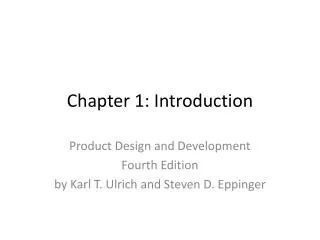
Chapter 1: Introduction Product Design and Development Fourth Edition by Karl T. Ulrich and Steven D. Eppinger
Goals of Book and Course • Examine structured approaches to product design and development (e.g. functional decomposition, set-based design, …) • Develop the knowledge and tools to be able to work successfully on cross functional teams (e.g. identify customer needs, intellectual property, economic decision making, …)
Bias of the Book • Assumes a For-Profit enterprise • Considers primarily Discrete Goods (printers, and power drills rather than plastic film) • Considers primarily Physical Products rather than engineering services or software.
Bias of the TeacherSMIU Rules for Good Design • Does not hurt anyone • Makes money • Works OK
Excellent Design • Enhances lives • Makes tons of money • Delights the user
Role of Structured Methods • Creativity vs. Recipe in design • Creativity vs. Recipe in product development process
Effect of Organization • The organization or structure of design teams can significantly affect your life and the company.