Comprehensive State Management System with Binary Tree Implementation
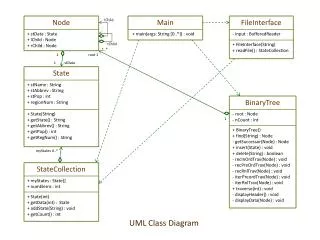
This system utilizes a binary tree structure for efficient management of state data, incorporating key attributes such as state name, capital, abbreviation, population, and region. The main functionality includes file reading for state data, along with methods for inserting, deleting, and traversing the tree. The user can access detailed information about each state, ensuring quick retrieval and organization of data. This design also supports various traversal methods, making it versatile and suitable for educational purposes or data management applications.

Comprehensive State Management System with Binary Tree Implementation
E N D
Presentation Transcript
Node lChild Main FileInterface + stData : State + lChild : Node + rChild : Node + main(args: String [0..*]) : void - input : BufferedReader rChild + FileInterface(String) + readFile() : StateCollection 1..* 1 root 1 1 stData - stName : String - stCapital : String - stAbbrev : String - stPop : int - stRegion : String - regionNum : String State + stName : String + stAbbrev : String + stPop : int + regionNum : String BinaryTree + State(String) + getState() : String + getAbbrev() : String + getPop() : int + getRegNum() : String - root : Node - nCount : int 1 • + BinaryTree() • + find(String) : Node • getSuccessor(Node) : Node • + insert(State) : void • + delete(String) : boolean • recInOrdTrav(Node) : void • recPreOrdTrav(Node) : void • recRnlTrav(Node) : void • iterPreordTrav(Node) : void • iterRnlTrav(Node) : void • + traverse(int) : void • - displayHeader() : void • - displayData(Node) : void myStates 0..* StateCollection + myStates : State[] + numElems : int + State(int) + getData(int) : State + addState(String) : void + getCount() : int UML Class Diagram