Download
1 / 4
60 likes | 434 Vues
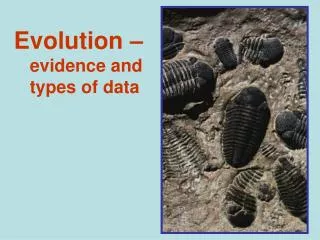
Scientists cannot directly date most fossils; instead, they date the surrounding rock layers. The oldest rocks are found in lower strata, with progressively younger rocks above. Relative age dating involves comparing rock layers to determine their ages and, by extension, the ages of fossils within those layers. Index fossils help establish relative ages and must meet two criteria: they should be widely distributed and exist for a short geologic time. By utilizing this method, scientists piece together the timeline of Earth's history and the evolution of life.

E N D
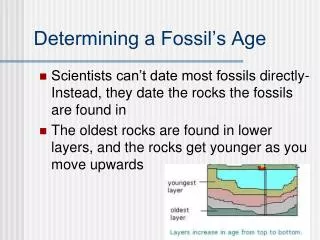
Determining a Fossil’s Age Scientists can’t date most fossils directly-Instead, they date the rocks the fossils are found in The oldest rocks are found in lower layers, and the rocks get younger as you move upwards
Relative-Age Dating By comparing the age of a rock layer to the rock layers near it, scientists can determine the relative age of the rock – and the relative age of any fossils found in that rock layer.
Using Index Fossils Can be used to determine the relative ages of the rocks they were found in Index fossils must follow 2 rules: 1. Must have been widely distributed 2. Must have only lived for a short period of time
Fossil A – 250 – 200 myaFossil C – 400 mya – 100 mya Fossil B – 400 – 100 mya Fossil D – 100 mya - present Index fossils (cont.)