
DNA: The Genetic Material and Replication Process
E N D
Presentation Transcript
In the beginning… • Is the genetic material in cells protein or DNA? • In order to be the genetic material, it must be… • Able to store information that pertains to the development, structure and metabolic activities of the cell • Stable so that it can be replicated • Able to undergo changes (mutations) to allow for genetic variation and evolution
The BIG Question… • How can DNA carry the genetic code? • Proteins contain 20 different amino acids that can be organized in countless ways to determine traits • Nucleic acids only contain 4 different nucleotides
Scientists that helped us figure it out… • Frederick Griffith • Was trying to find a vaccine against pneumonia • Found that one type of bacteria could turn into another (transformation) • Avery • Determined that Griffith’s results were due to DNA and not protein
Scientists that helped us figure it out… • Hershey – Chase • Worked with viruses that infect bacteria (bacteriophages) • Used radioactive sulfur to tag protein and radioactive phosphorus to tag DNA • The radioactive DNA moved into the bacteria • Proved that DNA is the genetic material in viruses
Scientists that helped us figure it out… • Chargaff • Compared ratios of the 4 nucleotides • Found that in every species A = T and G = C • This is known as Chargaff’s rule • Pyrimidine nucleotides – single ringed • thymine and cytosine • Purine nucleotides – double ringed • adenine and guanine • Always match a pyrimidine with a purine
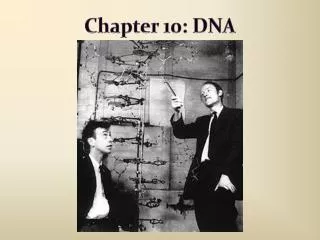
Scientists that helped us figure it out… • Franklin and Wilkens • Used X-ray diffraction to take pictures of DNA
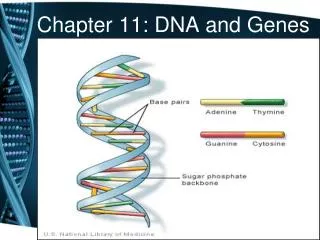
Scientists that helped us figure it out… • Watson and Crick • Put it all together and made the model! • DNA is a double helix • Sides of the ladder are deoxyribose and phosphate groups. These are held together by covalent bonds • The rungs of the ladder are the nitrogenous bases. These are held together by hydrogen bonds
More DNA deets • DNA is a polymer of nucleotides: • One base • Sugar – deoxyribose • Phosphate group • The deoxyribose carbons are numbered: • 1’ nitrogenous base • 5’ phosphate group • 3’ (hydroxide group) next phosphate group • The chains lie side by side in an antiparallel orientation • 5’ end to 3’ end
DNA Replication… • The process by which DNA makes a copy of itself • Occurs during interphase, before cell division • Semi-conservative: half of the original strand is always conserved to make the new strand • Enzymes are involved: • DNA helicase: separates the strands of the DNA molecule by breaking the hydrogen bonds between the nitrogenous bases – this forms a replication fork • DNA polymerase: moves from the 3’ end toward the 5’ end of the template strand and adds nucleotides • DNA ligase: binds the Okakazi fragments together
Replication… • New nucleotides can only be added in the 5’ to 3’ direction. • The side where this happens easily is called the leading strand. • The opposite strand is the lagging strand. Small sections are worked on. These new sections are called Okakazi fragments. • There are multiple replication forks all up and down the DNA strand.
http://www.stolaf.edu/people/giannini/flashanimat/molgenetics/dna-rna2.swfhttp://www.stolaf.edu/people/giannini/flashanimat/molgenetics/dna-rna2.swf • http://highered.mcgraw-hill.com/olc/dl/120076/bio23.swf http://www.mcb.harvard.edu/Losick/images/TromboneFINALd.swf