Energy Calculations for Aluminum Recycling and Heat Exchange Problems
80 likes | 209 Vues
This document discusses two problems involving energy calculations related to heat transfer in specific scenarios. The first problem examines the energy required to melt 1000 aluminum cans, each weighing 14.0 g at an initial temperature of 26.4°C, for recycling. The second explores the temperature equilibrium when hot coffee (0.300 kg at 95°C) is poured into a steel mug (0.125 kg at 20°C) and how to cool brewed tea (180 g at 32°C) using ice. Formulas for heat transfer and specific heat are applied to find solutions.


Energy Calculations for Aluminum Recycling and Heat Exchange Problems
E N D
Presentation Transcript
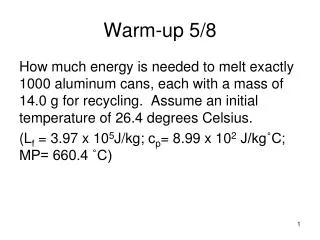
Warm-up 5/8 How much energy is needed to melt exactly 1000 aluminum cans, each with a mass of 14.0 g for recycling. Assume an initial temperature of 26.4 degrees Celsius. (Lf = 3.97 x 10⁵J/kg; cp= 8.99 x 10² J/kg˚C; MP= 660.4 ˚C)
0.300 kg of coffee, at a temperature of 95 °C, is poured into a room-temperature (20.oC) steel mug, of mass 0.125 kg. Assuming no energy is lost to the surroundings, what does the temperature of the mug filled with coffee come to?
Note that room temperature in Celsius is about 20°. Re-arranging the equation to solve for the final temperature gives:
The temperature of the coffee doesn't drop by much because the specific heat of water (or coffee) is so much larger than that of steel. This is too hot to drink, but if you wait, heat will be transferred to the surroundings and the coffee will cool.
Problem • A jar of tea is placed in sunlight until it reaches an equilibrium temperature of 32oC. In an attempt to cool the liquid to 0oC, which has a mass of 180 g, how much ice at 0oC is needed? Assume the specific heat capacity of the tea to be that of pure liquid water.
m tea = 180g m ice = ? which is the mass of the water that has melted c tea = c water = 4186 J/kgoC L f = 3.33 x 10⁵ J/kg and t final = 32oC Q lost = Q gained tea loses and water gains only melting the ice (mcDt)tea = (mLf)ice m ice= (mcDt)tea Lfice m ice = (.180kg)(4186J/kgoC)(32oC) 3.33x10⁵ J/kg = 7.2 x 10⁻²kg