Chestnut Blight
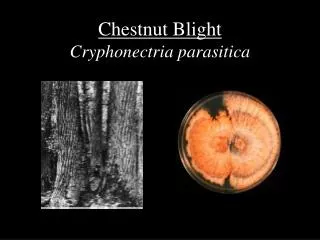
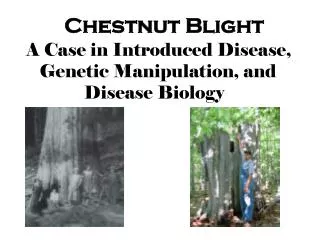
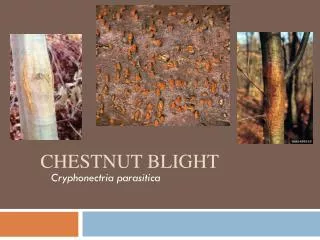
Chestnut Blight. Cryphonectria parasitica. Life Cycle. Wind-borne ascospores Conidia through rain splash Enters through wounds Grows in the inner bark Cankers. Location. Entire original range of American Chestnut Exists in Europe and Asia Surviving trees remain

Chestnut Blight
E N D
Presentation Transcript
Chestnut Blight Cryphonectriaparasitica
Life Cycle • Wind-borne ascospores • Conidia through rain splash • Enters through wounds • Grows in the inner bark • Cankers
Location • Entire original range of American Chestnut • Exists in Europe and Asia • Surviving trees remain in Northwest/California
Problems • 4,000,000,000 American chestnut trees lost • 50% of most eastern hardwood forests • Crucial food source • Most surviving trees only exist as sprouts • Disappeared from lumber markets • Rural areas relied heavily on nut harvests
Origin • Asian trees imported into U.S. • Discovered in 1904 • Japanese/Chinese trees were resistant
Range and Spread • Local infections • Up to 50 miles per year • Carried by wind, insects and rain splash • From Mississippi to Maine
Methods of Control • Breeding for resistance • Chinese Chestnut tree • Control imported from Europe • Hypovirulence
Bibliography • "Life Cycle of Chestnut Blight — School of Forest Resources — Penn State University."School of Forest Resources — Penn State University. College of Agricultural Sciences. Web. 21 Sept. 2011. <http://sfr.psu.edu/public/chestnut/breeding/blight/life-cycle/view>. • This source helped me to understand the life cycle of Chestnut Blight through the use of a flow chart. • Worrall, Jim. "Forest Pathology - Chestnut Blight." Forest and Shade Tree Pathology - Home. 27 May 2007. Web. 21 Sept. 2011. <http://www.forestpathology.org/dis_chestnut.html>. • This article provided important information on ways in which the virus is being controlled along with opportunities for hybrid breeding. • Anagnostakis, Sandra L. "CAES: Fact Sheets." CT.gov Portal. Web. 21 Sept. 2011. <http://www.ct.gov/caes/cwp/view.asp?a=2815>. • This site provided me with information on where Chestnut Blight originated. • "The American Chestnut Foundation - Mission & History." The American Chestnut Foundation - Restoring the American Chestnut Tree. Web. 21 Sept. 2011. <http://www.acf.org/history.php>. • This organization is responsible for reviving the population of American chestnuts and provided information on why the American chestnut was so important to society. • "Cryphonectria_parasitica." Columbia University in the City of New York. Web. 21 Sept. 2011. <http://www.columbia.edu/itc/cerc/danoff-burg/invasion_bio/inv_spp_summ/Cryphonectria_parasitica.htm>. • This site detailed the current range of Chestnut Blight