Chestnut Blight A Case in Introduced Disease, Genetic Manipulation, and Disease Biology
The American chestnut once comprised 25% of the eastern deciduous forest. The nuts were once an important economic resource in the U.S. The wood is straight-grained, strong, and easy to saw and split. Being rich in tannins, the wood was highly resistant to decay and therefore used for a variety of purposes, including furniture.
Chestnut blight, or chestnut bark disease, is caused by an introduced fungus, Cryphonectria parasitica The fungus enters wounds, grows in and under the bark, and eventually kills the cambium all the way around the twig, branch, or trunk.
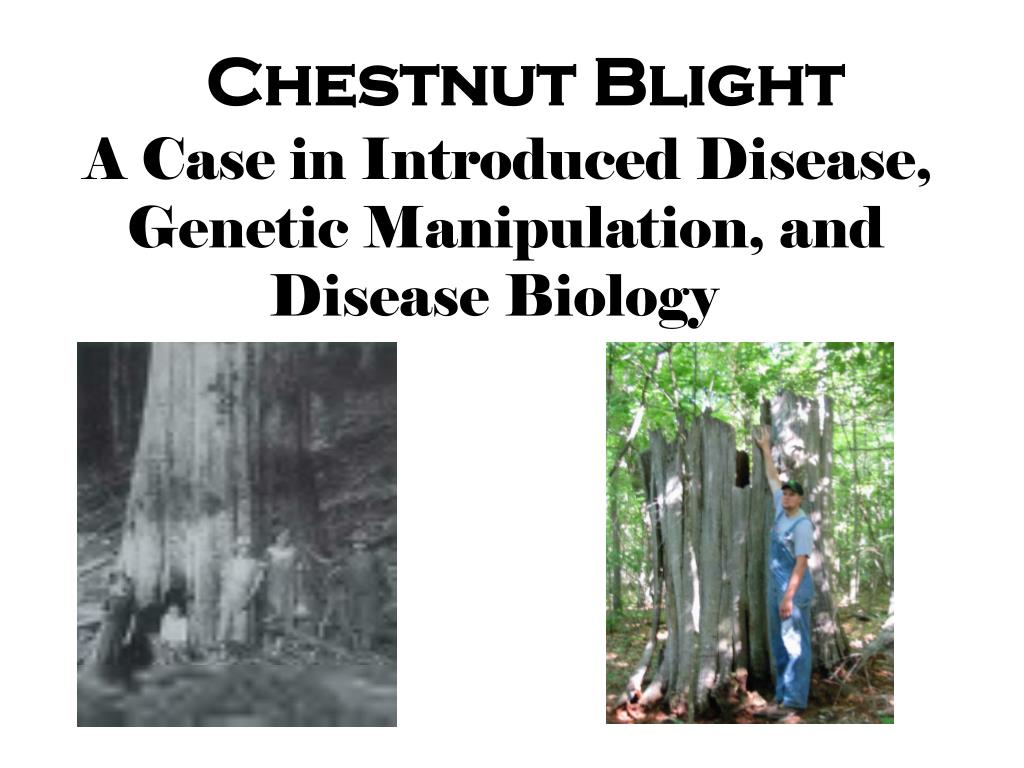
Cankers were first reported in the United States in 1904 on American chestnut trees Castanea dentata in New York City. An American chestnut tree growing in Connecticut in 1905. The tree was 83 feet tall, 27 inches in diameter, and 103 years old.
By 1926 the fungus was reported throughout the native range of American chestnut, and a major forest tree had been reduced to a multiple-stemmed shrub. In 1912 the Plant Quarantine Act was passed to reduce the chances of such a catastrophe happening again.
The blight fungus moves from tree to tree as spores on the feet, fur, and feathers of the many animals and insects that walk across the cankers. Sprouts develop from a burl-like tissue at the base of the tree called the ‘root collar,’ which contains dormant embryos. Sprouts grow, become wounded and infected, and die, and the process starts all over again.
There has been little chance for disease resistance to evolve in American chestnut, since the sprouts that come up after trees are killed by chestnut blight disease are often killed before they become sexually mature. Since two flowering chestnut trees are needed for seed formation (they must be cross- pollinated), sexual reproduction has been drastically reduced.
Breeding plans have been developed for making hybrids of resistant Asian trees with susceptible American trees. The hybrid trees would have the qualities of the American chestnut, along with the disease resistant qualities of the Asian tree.
Researchers have determined that the disease resistance is determined by two independent genes. By selecting certain types for breeding, the desired genetic characteristics can be achieved. It is now known that the heterozygous condition only renders partial resistance to the disease.
Parental Cross: One parent homozygous Dominant for both genes (PD), one parent homozygous recessive (Pd) for both genes. AABB x aabb 100% AaBb The F1 generation is now heterozygous for both genes. The heterozygous individuals are only partially resistant
Parental Cross AABB x aabb
A back cross is used to verify the assumptions of genetic identity of the P generation, and to produce individuals with different combinations of the genes (different genotypes). A backcross of an F1 individual and a parental genotype should result in a population in which 25% of the individuals will have partial resistance. AaBb x aabb
Remember, the genes are independent, so during meiosis the gene alleles can sort independently. What are the possible gametes for each parent? aabb: ab is the only possibility AaBb: The possibilities are: AB Ab aB ab Now do the Punnett Square!
Back cross: F1 x Pd AB Ab aB ab ab AaBb Aabb aaBb aabb 25% of the offspring will have a partial resistance to the fungus, 75% will be totally susceptible to it.
F1 x Pd Back cross: AaBb x aabb
Crossing two of the F1 progeny should produce 1/16 of the F2 generation with the homozygous dominant condition, giving them full resistance to the fungus. AaBb x AaBb Start by listing the possible gametes for each. Both are AaBb: The possibilities are: AB Ab aB ab Now do the Punnett Square!
Progeny cross: F1 x F1 AB Ab aB ab AB AABB AABb AaBB AaBb AaBb Aabb Ab AABb AAbb aaBB aaBb aB AaBB AaBb AaBb Aabb aabb ab aaBb
F1 x F1Progeny cross: AaBb x AaBb