Download
1 / 7
70 likes | 179 Vues
This resource explores the origins and structure of American federalism, specifically highlighting three major problems faced under the Articles of Confederation due to decentralized power. For each identified issue, a corresponding solution provided by the U.S. Constitution is discussed, clarifying the division of power across federal, state, and local levels. Key concepts such as delegated, reserved, and concurrent powers are examined, along with fiscal federalism, its advantages, disadvantages, and implications for governance.

E N D
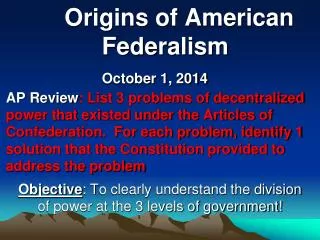
Origins of American FederalismOctober 1, 2014AP Review: List 3 problems of decentralized power that existed under the Articles of Confederation. For each problem, identify 1 solution that the Constitution provided to address the problem Objective: To clearly understand the division of power at the 3 levels of government!
I. Federalism • Definition: • Constitutional • Delegated • Implied • Denied • Reserved • Concurrent • Governing States: • Denied • Full Faith/Credit • Extradition • Article 4.2.3
I. Federalism • National Supremacy • Article 6.2 • McCulloch v. Maryland • Gibbons v. Ogden • Brown v. Board, 1954 • Civil Rights Act, 1964
II. Fiscal Federalism • Grants • Categorical (Project/Formula) • Block • “Heavy-Handed” • Mandates • ADA • Clean Air Act • Cross-over Sanctions • Cross-cutting requirements
II. Fiscal Federalism • Dual Federalism • “Layered Cake” • Cooperative Federalism • “Marble Cake” • Conservative Revolution • Post 1980s
III. Federalism Conclusion Advantages Disadvantages Financial Burden Heavy Handed Blackmail Unequal services Redundancy • Decentralizes • Checks • Resources • Experimentation • Geography
TO DO • Turn to a person next to you and DEFINE Federalism • IN YOUR NOTES • What are 5 reasons for Federalismif you say it allows states to better deal with local issues…provide examples