Introduction to Semantics in Language Analysis
Understand the basics of semantics and predicates in language with examples. Learn about referring expressions, predicators, and degree of predicates to enhance your linguistic knowledge.


Introduction to Semantics in Language Analysis
E N D
Presentation Transcript
Topic 3: predicates Introduction to Semantics
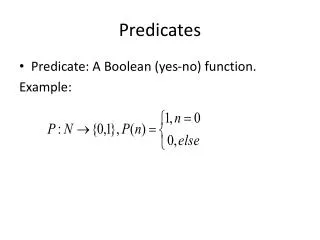
Definition • Any word which can function as the predicator of a sentence. • Predicators • The parts which are not referring expressions • Nouns, verbs, adjectives, preposition • NOT conjunctions (and, but, or, so), articles (a, the) • A predicate can only have one sense in a sentence. • A word may have multiple senses.
Semantic elements of a simple declarative sentence • Referring expressions = arguments • Predicator = predicate • Example: • Romeo loves Juliet. • Arguments=Romeo, Juliet • Predicate=love
Degree of a predicate • The degree of a predicate is determined by the number of arguments • One-place predicate • Requires one argument • John kicks. • Two-place predicate • Requires two arguments • John kicks the ball.
How do we talk about the non-existent things? • Can language be used to talk about an unreal imaginative world? • Harry Potter • Narnia