
The Autonomous navigation Robot
210 likes | 506 Vues
The Autonomous navigation Robot. By: 1- Aws Al- Nabulsi 2- Ibrahim Wahbeh 3- Odai Abdallah Supervised by: Dr. Kamel Saleh. Overview. The main idea of the project is to create an open source hardware and software robotic platform that can be easily adapted to do several tasks.
The Autonomous navigation Robot

E N D
Presentation Transcript
The Autonomous navigation Robot By: 1- Aws Al-Nabulsi 2- Ibrahim Wahbeh 3- OdaiAbdallah Supervised by: Dr. KamelSaleh
Overview • The main idea of the project is to create an open source hardware and software robotic platform that can be easily adapted to do several tasks. • Features of this platform: • Map construction • Localization • Path planning and obstacle avoidance • speech and object recognition
Map Construction and path planning • Estimated position (X1,Y1) • Target position (X2,Y2) • Optimum path • Move
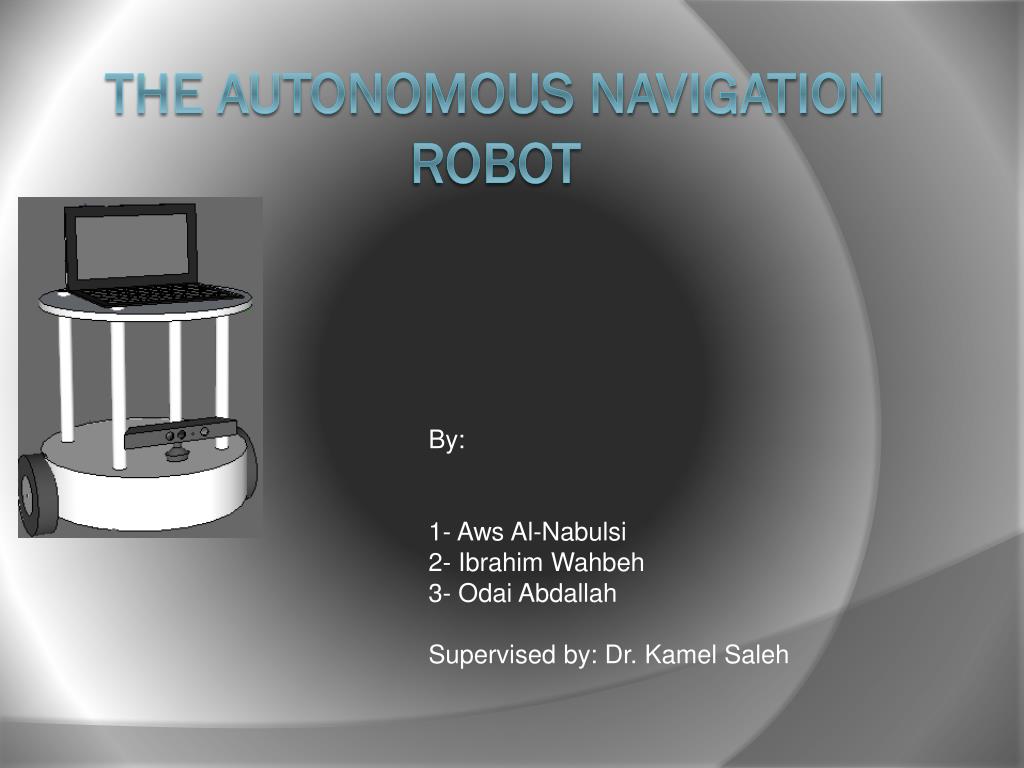
Hardware Design Body Design showing the various parts of the robot 1) Mother Board 2) Kinect sensor 3) Base 4) Wheels
The Base Controller The Base controller contains: 1)Microcontroller 2)Drive Circuit 3)Two Stepper motors 4)Battery
Choosing the motors • Torque calculations: The following formulas were used to determine the required torque T = F friction *R F friction = µ * m * g the estimated parameters for the robot are: R= 6 cm , µ = 0.35 , m= 7 kg , g=9.81 m/S2 Substituting these parameters into the equations, We get a required torque of T = 7.3545 Kg-cm per motor.
Motors used: • Two steper motors • SpecificationsSize: Nema 23 Phase: 2 PhaseStep Angle: 1.8 DegreesVoltage: 70V MaxRated Current: 2.8AInductance: 4.7mHDual ShaftBipolar 4 Wire
Drive circuit A dual H-bridge with a maximum total current of 4 A will be used to drive the motors
The arduino microcontroller • Main tasks: • send/receive data. • Odometry calculations. • Motor commands.
Kinect sensor • Features of the kinect: • RGB image • IR image • Depth map • Skeleton and object tracking
odometry calculations The term odometry means the robot coordinates in x, y and theta. And the velocity v of the robot ∆ Distance= ∆ encoder pulses * Distance per pulse ϴ Right distance = previous right distance + ∆ right distance. Left distance = previous left distance + ∆ left distance. ∆ X = ∆ distance * cos (ϴ). ∆ Y = ∆ distance * sin (ϴ). X= previous x + ∆ x. Y= previous y + ∆ y. Now to calculate the heading (ϴ): ∆ ϴ = (∆ right distance - ∆ left distance) / b. Where b is the distance between the wheels. And ϴ = previous ϴ + ∆ ϴ.
Translating the desired linear and angular velocities into motor commands: VR = V + (b * W)/2 VL = V – (b* W)/2
Thank you for your attention Questions?