Download
1 / 13
130 likes | 241 Vues
This study explores the effects of subgrid-scale (SGS) microphysics in the UCLA-LaRC Single Column Model (SCM) using the Intermediately Prognostic Higher-Order Closure (IP-HOC) model. We evaluate the performance of the SGS microphysics scheme, comparing results from the UCLA-LaRC SCM to those from 3D and 2D Small-Area Models (LES) with a specific focus on rain water collection rates and the impact of varying configurations. Findings indicate that while reasonable results are produced, the autoconversion rates require refinement for improved accuracy in precipitation predictions.

E N D
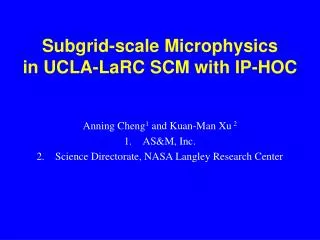
Subgrid-scale Microphysics in UCLA-LaRC SCM with IP-HOC Anning Cheng1 and Kuan-Man Xu 2 AS&M, Inc. Science Directorate, NASA Langley Research Center
Outline • Intermediately prognostic (IP) higher-order closure (HOC) model • Results form UCLA-LaRC SCM, 3D-SAM LES and 2D-SAM LES with IP-HOC • Subgrid-scale (SGS) microphysics scheme in UCLA-LaRC SCM • Effects of the SGS microphysics scheme
2D-SAM LES (with IP-HOC) Configuration • Domain size is 250 km • Horizontal grid size is 200 m • The 2D LES is aligned in either x direction (Exp. U) or y direction (Exp. V) • The rest of configuration is the same as in the 3D LES
Subgrid-scale Autoconversion • The original Kessler’s autoconversion rate is simply proportional to the grid-mean cloud water mixing ratio, subject to a threshold value • An integration of the Kessler’s formula multiplied by the subgrid-scale Double-Gaussian pdf found that subgrid-scale autoconversion is a function of mean, variance, and skewness of liquid water potential temperature and total water mixing ratio • What is the effect of including the new subgrid-scale autoconversion formulation?
Summary and Discussion • UCLA-LaRC SCM produces reasonable results for the RICO case although improvement is still needed • Subgrid-scale microphysics is essential for the IP-HOC model to produce precipitation • The cloud amount and cloud top height decreased drastically when subgrid-scale autoconversion rate was used • Compared to 3D LES, the autoconversion rate is too high, but the collection rate is reasonable in the SCM simulation athough their formula are very simple