The Federalists in Power: Political Turmoil from 1796 to 1800
This overview explores the Federalist Party's political struggles during John Adams' presidency from 1796 to 1800. Key events include the Election of 1796, the tensions of the XYZ Affair, and the enactment of the Alien and Sedition Acts aimed at suppressing opposition. The election of 1800 signifies the rise of the Democratic-Republicans, highlighting the split within the Federalists and the eventual downfall of their party. The era is marked by significant foreign affairs issues and internal political divisions that reshaped the future of American governance.

The Federalists in Power: Political Turmoil from 1796 to 1800
E N D
Presentation Transcript
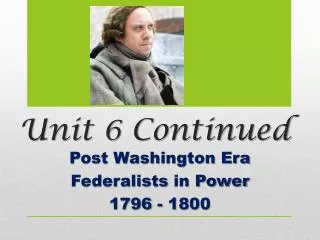
Unit 6 Continued Post Washington Era Federalists in Power 1796 - 1800
First Election w/ Political Parties (Partisan) • Dominated by Foreign Affairs • Split in loyalty of Federalists • Hamilton backs Thomas Pinkney • Jefferson brought out of “Retirement” Election of 1796
Election of 1796 • Results: • John Adams 1st – President • Jefferson 2nd – Vice President • Different Political Parties
President John Adams • Obstacles: • Succeeding Washington • Political factions • Retains Washington’s Cabinet • Causes problems because of loyalty to Hamilton
President John Adams • Foreign Affairs • War in Europe • French hostility towards U.S. • Resent Federalists ties w/ England • Personality • Arrogant (unlikable)
The X,Y,Z Affair 1797 • U.S. Diplomats to France • Request meeting w/ Prince Talleyrand • Foreign Minister • French Agents request • Apology for Adams speech • $10 mill. Loan • $250 thousand bribe • U.S. outrage • “Millions for defense but not one cent for tribute”
The X,Y,Z Affair 1797 • Results • Break in relations w/ France - stop of all trade • Hires Privateers • Leads to undeclared Naval War
Undeclared Naval War • Build up of U.S. Military • Raised taxes • Creates Secretary of the Navy • 80 ships lost on both sides • Adams seeks to minimize conflict • Despite public outcry • 1800 Napoleon to power • Ends Treaty of Alliance • U.S> has no obligation to support France, US gave up claim against Damaged ships “War” With France 1798
Enacted by Federalists • Passed a series of laws to suppress Republican opposition & insure power for their own party. • Naturalization Acts • extended the time it took to become a citizen from 5 to 14 years. • Belief that most foreigners joined the Republicans. The Alien & Sedition Acts 1798
The Alien & Sedition Acts 1798 • Alien Acts • President has the power to deport any alien he thought dangerous to the nation’s security. • In time of war, the power to deport or arrest all aliens who come from an enemy nation
Sedition Act 1798 • No Criticism of President / Congress / Cabinet • Heavy fines & Jail • 25 Democratic Republican publishers arrested • Some to jail • Thomas Cooper • Leads to downfall of Federalists The Alien & Sedition Acts 1798
Democratic Republicans response to Alien & Sedition Acts • Written secretly by Jefferson & Madison • Called for: • Freedom of Speech / Press • End to Central Govt. Tyranny • “States Rights” • Nullification • States judge Constitutionality of Laws • May declare Laws “Null & Void” • Major issue in Civil War Virginia & Kentucky Resolutions1798
Election of 1800 • Resentment against Federalists • Alien & Sedition Acts • Split between Hamilton & Adams • Candidates • Federalists: • John Adams & C.C. Pinckney • Republicans • Thomas Jefferson & Aaron Burr • “Dirty Campaign”
Election of 1800 • Election a tie • Jefferson & Burr • Decided in House of Representatives • 36 Ballots • Great debate • Hamilton verbally attacks Burr • “Most unfit man to be President”
Thomas Jefferson will become president and Aaron Burr will become vice president. • The Election of 1800 was the last time the Federalists came close to winning an election. • The 12th Amendment is added in 1804 to prevent this problem. Election of 1800
Achievements: • Established workable Govt. • Prosperous economy – Manufacturing based • Reasons for Federalist downfall • Viewed as favorable to Upper Class • Distrust of common man • Pro-British policies • Alien & Sedition Acts Decline of the Federalist Party