FOR 201 Microcomputer applications
FOR 201 Microcomputer applications. Hardware. Digital world - review. Data representation refers to the form in which data is stored, processed, and transmitted Digital devices work with distinct and separate data Analog devices work with continuous data

FOR 201 Microcomputer applications
E N D
Presentation Transcript
FOR201Microcomputer applications Hardware
Digital world - review • Data representation refers to the form in which data is stored, processed, and transmitted • Digital devices work with distinct and separate data • Analog devices work with continuous data • Digitizing - the process of converting analog data into digital format • Numeric data • Decimal system (0, 1, .., 9) • Binary system (0 and 1)
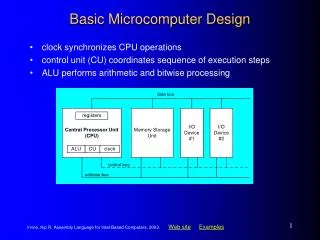
Microprocessors • A microprocessor is an integrated circuit designed to process instructions • Interprets the instructions of a computer program and processes data The fundamental operation is to execute a sequence of stored instructions, called a program.
Memory • Random Access Memory (RAM) • Random Access Memory is a temporary holding area of data, programs, and the operating system • Microscopic capacitors hold bits representing data • Most RAM is volatile
Memory • Read-Only Memory (ROM) • Type of memory that holds the computer startup routine • Permanent and non-volatile
Storage devices • A storage medium contains data • A storage device records and retrieves data from a storage medium • Data gets copied from a storage device into RAM, where it waits to be processed • Processed data is held temporarily in RAM before it is copied to a storage medium
Storage devices • Magnetic storage stores data by magnetizing microscopic particles on the disk or tape surface
Storage devices Hard disk platters and read-write heads are sealed inside the drive case to screen out dust and other contaminants.
Storage devices • Optical storage stores data as microscopic light and dark spots on the disk surface • CD and DVD storage technologies
Storage devices • Today’s DVD drives typically have 16X speeds for a data transfer rate of 177.28 Mbps • Three categories of optical technologies • Read-only (ROM) • Recordable (R) • Rewritable (RW)
Solid State Storage • Solid state storage technology stores data in an erasable, rewritable circuitry • Non-volatile • Card reader / interface is required to read data on solid state storage
Solid State Storage • A USB flash drive is a portable storage device that plugs directly into a computer’s USB port using a built-in connector
Storage devices - obsolete • A floppy disk is a round piece of flexible Mylar plastic covered with a thin layer of magnetic oxide and sealed inside a protective casing • A tape drive is a device that reads data from and writes data to a long stream of recordable media • A tape is a SEQUENTIAL storage medium
Basic input devices • Keyboard • Pointing device • Pointing stick • Trackpad • Trackball • Joystick • Touch screen
Display devices • A CRT display device uses a bulky glass tube • An LCD manipulates light within a layer of liquid crystal cells • Plasma screen technology illuminates lights arranged in a panel-like screen
Display devices - properties • Viewable image size • Dot pitch • Viewing angle width • Refresh rate • Color depth • Resolution • VGA, SVGA, XGA, SXGA, UXGA or WUXGA
Printers • An ink-jet printer has a nozzle-like print head that sprays ink onto paper • A laser printer works like a photocopier • Dot matrix printers produce characters and graphics by using a grid of fine wires
Printers • Printer features • Resolution • Print speed • Operating costs • Duplex capability • Memory
Glossary • LCD: liquid crystal display • CRT: cathode ray tube • Dot pitch: distance between dots of the same color • Viewing angle width: angle at which you can clearly see the screen image from the side • Refresh rate: speed at which the screen is repainted • Color depth: number of bits determining the range of possible colors that a pixel can have • Resolution: grid’s density used to display/print