Une image / un lien ci-dessous est fourni (tel quel) pour télécharger la présentation
Politique de téléchargement : le contenu du site vous est fourni TEL QUEL pour votre information et votre usage personnel ; il ne peut être vendu, concédé sous licence ni partagé sur d’autres sites sans l’accord de son auteur.Le contenu vous est fourni TEL QUEL, pour votre information et votre usage personnel uniquement.Téléchargez la présentation en cliquant sur ce lien.Lors du téléchargement, si vous ne parvenez pas à télécharger une présentation, l’éditeur a peut-être supprimé le fichier de son serveur.Pendant le téléchargement, si vous ne parvenez pas à obtenir une présentation, le fichier a peut-être été supprimé par l’éditeur.
What do you think? Before you begin, decide if you agree or disagree with each of these statements. As you view this presentation, see if you change your mind about any of the statements. Chapter Introduction
1. Earth’s surface is made up of tectonic plates. 2. Tectonic plate motion is too slow to measure. 3. Most earthquakes occur near tectonic plate boundaries. 4. Volcanoes can erupt anywhere. Do you agree or disagree? Chapter Introduction
Earth’s Moving Surface • What is the theory of plate tectonics? • What are the differences between divergent, convergent, and transform plate boundaries? • What causes tectonic plates to move on Earth’s surface? Lesson 1 Reading Guide - KC
Plate Tectonics • The theory of plate tectonics states that Earth’s surface is broken into large, rigid pieces that move with respect to each other. • These pieces, or tectonic plates, move slowly over Earth’s surface. Lesson 1-1
Plate Tectonics (cont.) • The Earth’s crust and uppermost part of the mantle make up the lithosphere. • The lithosphere forms a rigid shell on the outside of Earth which is broken into tectonic plates. Lesson 1-1
Plate Tectonics (cont.) • The partially melted portion of the mantle below the lithosphere is the asthenosphere. • The asthenosphere is hotter than the lithosphere and can bend more easily. Lesson 1-1
Plate Boundaries • Scientists describe the movement of tectonic plates, in terms of relative motion—how it moves in relation to another plate. • As plates move relative to each other, they form different types of boundaries. • The type of boundary depends on the relative motion of the plates. Lesson 1-2
Plate Boundaries(cont.) • A boundary where two plates move away from each other is called a divergent boundary. • As plates at a divergent boundary move apart, new crust forms between them. Lesson 1-2
Plate Boundaries(cont.) • A boundary where two plates move toward each other is a convergent boundary. • In some convergent boundary locations, one plate is pushed under the other plate and down into the mantle where it melts and becomes part of the mantle. Lesson 1-2
Plate Boundaries(cont.) Subduction is the process that occurs when one tectonic plate moves under another tectonic plate. Lesson 1-2
Plate Boundaries(cont.) What are the differences between divergent, convergent, and transform plate boundaries? Lesson 1-2
Measuring Plate Movement • Tectonic plates move horizontally over Earth's surface. • During the 1970s, scientists and engineers developed new technologies that enabled them to measure how fast tectonic plates move. • The position of any point on Earth’s surface can be accurately measured using the network of satellites known as the Global Positioning System (GPS). Lesson 1-3
Measuring Plate Movement(cont.) • A divergent boundary formed between North America and Europe about 200 million years ago. • The plates moved apart, and the Atlantic Ocean formed. • North America is separating from Europe at an average rate of just 2.5 cm per year. Lesson 1-3
Why do tectonic plates move? • The circulation within fluids caused by differences in density and thermal energy is called convection. • Convection occurs in Earth’s asthenosphere, just below the lithosphere. Lesson 1-4
Why do tectonic plates move?(cont.) • Another process that causes plate movement is subduction. • When two plates collide, one can subduct or sink into the hotter, less-dense mantle. • When this happens, the rest of plate is pulled along behind the sinking part of the plate. Lesson 1-4
Shaping Earth’s Surface • Where do most earthquakes occur? • How are landforms related to plate tectonics? • Where do most volcanoes form? • How does plate movement form mountains? Lesson 2 Reading Guide - KC
Earthquakes occur at faults. • A faultis a crack or a fracture in Earth’s crust along which movement occurs. • Convection currents beneath tectonic plates force the rocks on either side of the fault to move. Photograph by N.J. Silberling, USGS Photo Library, Denver, CO Lesson 2-1
Earthquakes(cont.) fault Science Use a fracture in the crust of a planet Common Use responsibility for wrongdoing or failure Lesson 2-1
Earthquakes(cont.) • Most earthquakes occur at plate boundaries. • A plate boundary is made up of more than one fault and covers a large region. • Faults are largest where one plate subducts into the mantle, and the strongest earthquakes occur at these locations. Lesson 2-1
The convergent boundary between the Indian Plate and the Burma Plate (part of the Eurasian Plate) ruptured in 2004. The area of the rupture is indicated in green on the map. Smaller earthquakes have occurred in the purple areas. Lesson 2-1
Different types of movement occur at the three types of plate boundaries. • At a transform boundary, blocks of crust move horizontally past each other. • Features that cross the fault, such as streams, are shifted both by plate movement and by earthquakes. Lesson 2-1
At divergent boundaries between oceanic plates, mid-ocean ridges form. • Between continental plates, one side of the fault moves down relative to the other side of the fault. • Normal faults form valleys at these boundaries. Lesson 2-1
At subduction zones of convergent boundaries, the plate that does not subduct deforms and crumples as the two plates push toward each other. • As the mantle near the subducted plate melts, magma rises and forms a volcanic arc on the plate that does not subduct. Lesson 2-1
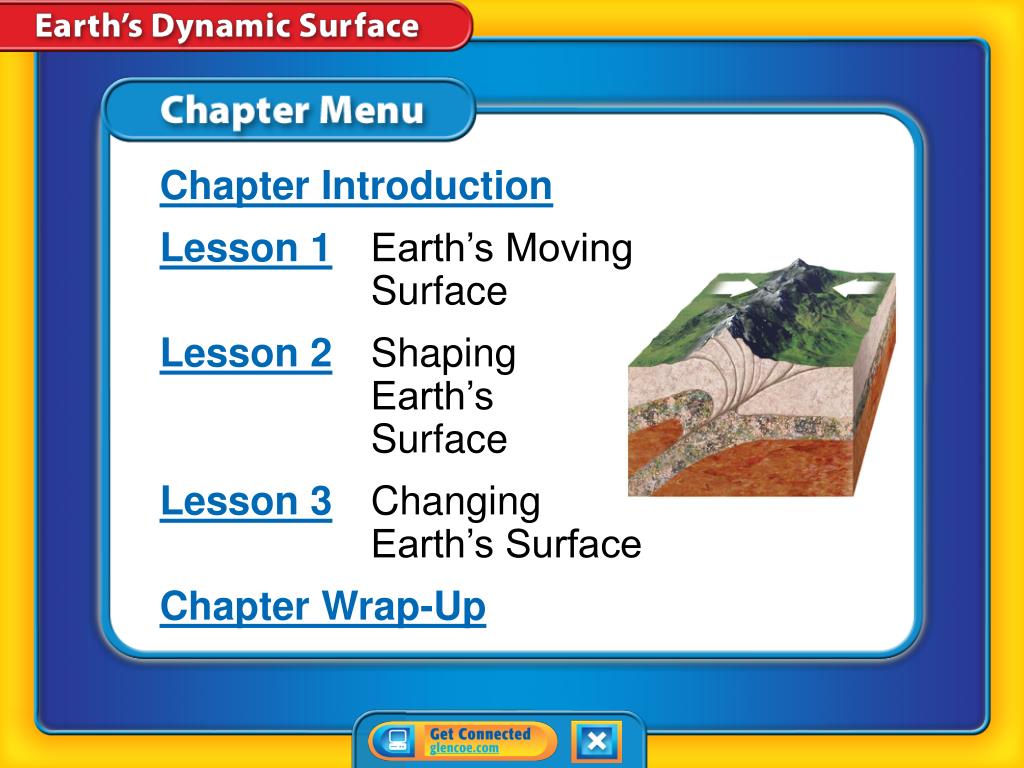
At convergent boundaries with no subduction, the edges of both tectonic plates become crumpled and deformed. • Because neither plate subducts, blocks of crust slide upward along a complex series of faults called reversefaults. • This results in the formation of tall mountains. Lesson 2-1
Earthquakes(cont.) How are landforms related to plate tectonics? Lesson 2-1
Volcanoes Volcanoes are vents in Earth’s crust through which molten rock flows. Lesson 2-2
Connexion au compte
Connectez-vous pour publier votre contenu sur SlideServe.