Understanding the Cell Cycle: Mitosis and DNA Replication
The cell cycle is a fundamental process where trillions of cells in our body are constantly dividing and performing specialized functions. DNA, stored in the cell nucleus, is replicated accurately during interphase, leading to two identical strands known as chromatids. Mitosis, which consists of four key steps (Prophase, Metaphase, Anaphase, and Telophase), ensures the equal distribution of genetic material. Cytokinesis follows to split the cytoplasm, resulting in the formation of two new daughter cells, highlighting the intricacy of cellular reproduction.

Understanding the Cell Cycle: Mitosis and DNA Replication
E N D
Presentation Transcript
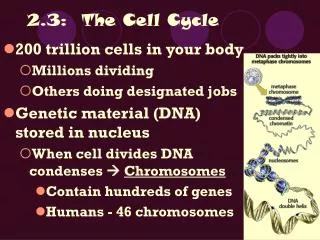
2.3: The Cell Cycle • 200 trillion cells in your body • Millions dividing • Others doing designated jobs • Genetic material (DNA) stored in nucleus • When cell divides DNA condenses Chromosomes • Contain hundreds of genes • Humans - 46 chromosomes
2.3: The Cell Cycle • DNA Replication • Cell makes copy of DNA before dividing • produces 2 identical DNA strands • Called chromatids • Held together by centromere • Interphase – most common cell phase • 90% of time • When cell does its job (not dividing)
2.2: The Cell Cycle • Cell cycle • Consists of several phases • Birth of a cell reproduction of new cell • Cells divide at different rates
2.3: Mitosis – Cell Division • DNA duplicated (interphase) must be divided between 2 daughter cells • Movement of chromosomes during Mitosis involves: • Centrioles • act like poles guiding cell division • Spindle fibers • help move chromosomes
2.3: Mitosis = 4 Steps (PMAT) • Prophase • DNA condenses into chromosomes • Nuclear envelope disappears • Chromosomes connect to spindle fibers
2.3: Mitosis = 4 Steps (PMAT) • Metaphase • Chromosomes line up in center of cell • Attached to spindle fibers
2.3: Mitosis = 4 Steps (PMAT) • Anaphase • Sister chromatids separate from their partners to opposite sides of cell • Spindle fibers shorten
2.3: Mitosis = 4 Steps (PMAT) • Telophase • 2 new Nuclei form (cells divide into 2) • Chromosomes uncoil • Mitosis ends
2.3: Cytokinesis • Cytokinesis • Splitting of the cytoplasm • Animal cells – pinches in to form 2 daughter cells • Plant cells – cell plate forms in middle