Download
1 / 28
280 likes | 388 Vues
Metabolism involves complex biochemical processes where proteins, composed of long chains of amino acids, play crucial roles. Enzymes, which are globular proteins, function specifically on individual substrates and can be categorized into hydrolytic enzymes that break down molecules and polymerase enzymes that synthesize new polymers. Metabolic pathways, including anabolic and catabolic processes, involve feedback mechanisms, with ATP acting as a vital energy currency. This overview highlights the principles of oxidation-reduction in respiration, the role of enzymes, and metabolic cycles in living organisms.

E N D
Enzymes work on only 1 substrate Each enzyme does only 1 job
Polymerase enzymes build up polymers molecules from monomers
Examples of oxidation/reduction in respiration • Fe3+ + electron Fe2+ • succinate + FAD fumarate + FADH2 • malate + NAD+ oxaloacetate + NADH + H+ • Pyruvate + NADH + H+ lactate + NAD
A metabolic chain starts with one substrate and ends with a different final product
A metabolic cycle starts and ends with the same substrate, something is added, something is taken away Citric acid
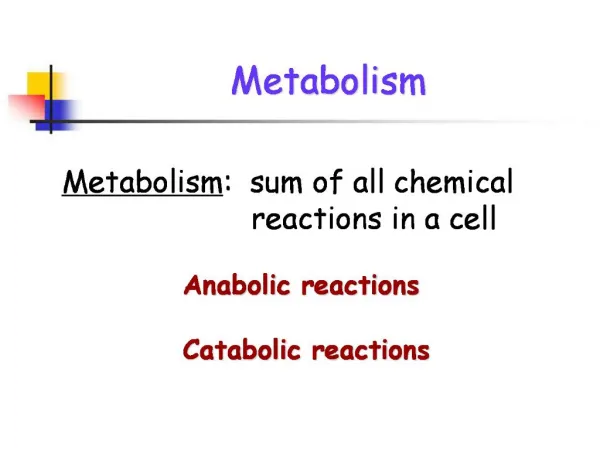
Anabolic Build up Add monomers together to make polymers Use polymerase enzymes Examples: Photosynthesis, Transcription, DNA replication Catabolic Break down more polymers to monomers Use hydrolytic enzymes Examples Cell respiration Digestion Metabolic pathways can be either/or
A Proton pump protein pumps protons Proton Pump An Electron Carrier protein carries electrons
A B C