Understanding Acid-Base Titration and pH Measurement
Chapter 16 discusses the principles of acid-base titration and the measurement of pH. It explains the self-ionization of water, the significance of the ion product constant (Kw), and defines pH as the negative logarithm of hydronium ion concentration. The chapter also covers acid-base indicators, their transition intervals, and the use of pH meters. Titration is a method for the controlled addition of a solution of known concentration to react with an unknown concentration. Key concepts include equivalence and end points in titrations and how to solve titration problems using mole ratios and molarity.

Understanding Acid-Base Titration and pH Measurement
E N D
Presentation Transcript
Chapter#16 Acid-Base Titration and pH
Chapter 16.1 • In the self-ionization of water, two water molecules produce a hydronium ion and a hydroxide ion by transfer of a proton. • Kw= H3O+ OH- • Kw= 1.0 X 10 -14 M2
The pH of a solution is defined as the negative of the common logarithm of the hydronium ion concentration. • The pH scale 0-14. 7 is neutral…pH<7 acid…pH>7 base • pH= -log ( H3O+)
Chapter 16.2 • Acid-base indicators are compounds whose colors are sensitive to pH. • pH range over which an indicator changes color is called its transition interval. • pH meter determines the pH of a solution by measuring the voltage between the two electrodes that are placed in the solution.
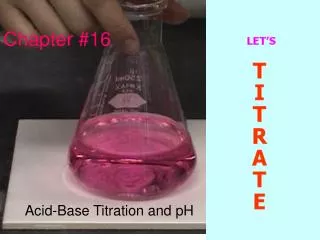
Titration is the controlled addition and measurement of the amount of a solution of known concentration required to react completely with a measured amount of a solution of unknown concentrations. • Equivalence point is the point at which the two solutions used in a titration are present in chemically equivalent amounts. • End point is the point in a titration at which an indicator changes color.
Titration Problems • Balance equation • Use the known solution to figure out the number of moles (M=mol/L) • Use the mole to mole ratio to figure out the moles of the unknown. • Determine the Molarity of the unknown using the given volume
“Flask”. May 7, 2007. http://www.chem.ualberta.ca/~iip/chem211irc/TotalSalt(start).jpg • “Let’s Titrate”. May 7, 2007. http://genchem.rutgers.edu/aanimate.gif • “Titration curve”. May 7, 2007. http://www.cofc.edu/~kinard/Applets/WeakAcidTitration.gif