Exploring Imagery and Sensory Descriptions in Poetry
In this engaging lesson, students focus on enhancing their sensory description skills through the application of imagery in poetry. Beginning with a bell ringer activity, they choose a well-known location, object, or person and describe it using at least two senses without revealing its identity. The session includes reading and analyzing a peer's poem, identifying sensory elements, and exploring main ideas through guided questioning. Finally, students transform their initial descriptions into three-stanza poems, honing their literary techniques while understanding the significance of imagery.

Exploring Imagery and Sensory Descriptions in Poetry
E N D
Presentation Transcript
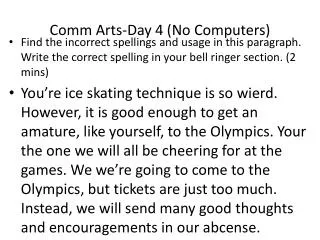
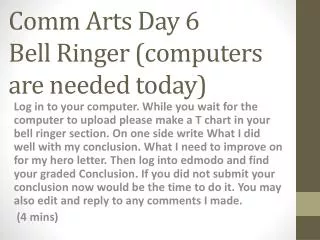
Comm Arts-Day 5 (no computers) • Bell Ringer: Choose a location, object, or person well known and use at least two of your senses to describe it. Don’t tell anyone what you are describing! (Four minutes) • Example: Her dark, black, silky hair is tied back as she her squeaky, yet deep voice carries across the basketball court. As she hollers the blue and white, shiny jerseys fly by. Her eyes grow wide with joy, her arms are bumpy from anticipation as she sees the final score. 22-34. Go Hershey. • Who is it?
Lesson Goal and Essential Question • Lesson Goal: Use literary techniques to convey meaning. • Essential Question: How do I convey my ideas clearly?
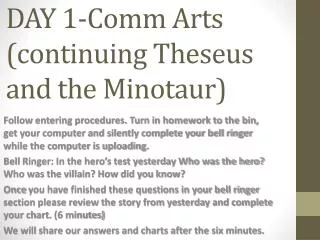
As we read… • The first time we read Katie’s poem, identify what senses she is using and what words she uses to describe that sense. (2 minutes) • The second time we read answer this question: What is the main idea of her poem? What are two lines that support this main idea best? (3 minutes) • What imagery does: Just like in the bell ringer, draw what you see as you read this third and final time. (3 minutes)
Stanzas and line breaks (3 minutes) • Now to exercise your brain a little more—take the description you wrote for your bell ringer and using stanzas and line breaks turn that description into a three stanza poem, with two lines in each stanza. • Example: • Her dark, black, silky • hair is tied back as she her squeaky, • yet deep voice carries across the basketball court. • As she hollers • the blue and white, • shiny jerseys fly by. • Her eyes grow wide with joy, • her arms are bumpy from anticipation • as she sees the final score. 22-34. Go Hershey.
Exit Ticket • What is the purpose of imagery? (2 minutes)