Download
1 / 10
100 likes | 209 Vues
Explore the essential properties of kites and parallelograms in geometry. This guide covers how to determine variable values using the properties of kites, explain the congruency of opposite sides and angles in parallelograms, and analyze consecutive angles summing up to 180 degrees. We provide examples and step-by-step solutions for finding unknown angle measures and side lengths, such as solving for x and y in given figures. Gain a comprehensive understanding of the relationships within these geometric shapes through practical applications.

E N D
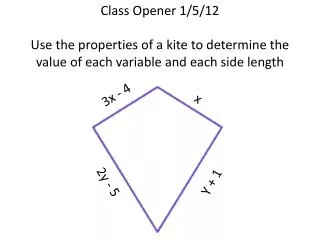
Class Opener 1/5/12Use the properties of a kite to determine the value of each variable and each side length 3x - 4 x 2y - 5 Y + 1
Properties of a Parallelogram • Opposite sides of a parallelogram are congruent.
Example • Find the value of x in PQRS 3x - 15 R Q P S 2x + 3
Properties of a Parallelogram • Opposite angles of a parallelogram are congruent.
Angles inside a Parallelogram • The angles inside any polygon that share a side are known as Consecutive Angles. A parallelogram has opposite sides parallel. Its consecutive angles are same side interior angles that add up to 180 degrees. X X + Y = 180 Y
Example • Find the value of Y in the following parallelogram. Then find all the angle measures. ? 3y +37 ? 6y + 4
Properties of a Parallelogram • The diagonals of a parallelogram bisect each other.
Example • Find the value of A and B A B + 10 B+2 2A – 8
Properties of Parallelograms • If 3 or more parallel lines cut off congruent segments on one transversal, then they cut off congruent segments on every transversal.
Example • In the figure to the right, DH CG BF and AE are parallel. AB = BC = CD = 2, and EF = 2.5. Find EH D H 2 C G 2 B F 2 2.5 A E