Download
1 / 21
210 likes | 346 Vues
Each community college district's board must adopt an annual budget by the first quarter of the fiscal year to cover necessary expenses and liabilities. The budget should detail the specific objects and purposes along with the associated costs. Boards can transfer up to 10% of total funds between budget items as needed. Revenue sources include local property taxes, ICCB grants, and tuition fees, while expenditures are categorized across various funds and functions like salaries, benefits, supplies, and maintenance. Proper budget management ensures transparency and accountability in financial reporting.

E N D
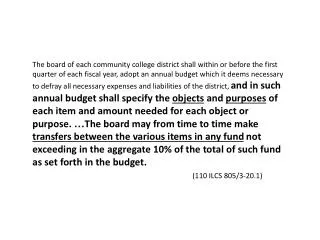
The board of each community college district shall within or before the first quarter of each fiscal year, adopt an annual budget which it deems necessary to defray all necessary expenses and liabilities of the district, and in such annual budget shall specify the objects and purposes of each item and amount needed for each object or purpose. …The board may from time to time make transfers between the various items in any fund not exceeding in the aggregate 10% of the total of such fund as set forth in the budget. (110 ILCS 805/3‑20.1)
Revenue • Local Property Taxes (41) • ICCB Operating Grants (42) • Base Operating (Cr Hr) • Square Footage • Equalization • ICCB Restricted Grants (42) • Workforce Development • Adult Education • Tuition and Fees (44)
Expenditure Budget Appropriated by Fund, Function, and Object
Funds • Operating Funds • Education (01) • Operations and Maintenance (02) • Auxiliary Enterprises (05) • Audit (11) • Liability, Protection, and Settlement (12) • Restricted Purposes (06) • Capital Funds • Bond and Interest (04) • Operations and Maintenance (Restricted) (03) • Other Funds • Working Cash (07) • Trust and Agency (17)
Function(Program, Activity) • Instruction (1) • Academic Support (2) • Student Services (3) • Public Service/ Continuing Education (4) • Auxiliary Enterprise (6) • Operation & Maintenance of Plant (7) • Institutional Support (8) • Scholarships, Grants, & Waivers (9)
Object • Salaries (51) • Employee Benefits (52) • Contractual Services (53) • Materials & Supplies (54) • Travel & Conferences (55) • Fixed Charges (56) • Utilities (57) • Capital Outlay (58)
Budget Management vsFinancial Reporting Budget Management Financial Reporting Expenditures are recorded to facilitate reporting of actual results. Entries must be posted accurately to ensure correct reporting and analysis. Move budget, not actuals unless posted in error. Budget assigns spending authority to managers; represents planned use of resources. Managers implement plan. Revenues are estimated; expenditures are budgeted contingent on revenues being achieved and cash collected.
Budget Management vsFinancial Reporting Budget Management Financial Reporting 51101 – Administrators 51201 – Professional 51301 – Faculty 51401 – Managers 51601 – Support staff 51602 – Support staff PT 51604 – Support staff OT • 51000 – Salaries
Budget Management vsFinancial Reporting Budget Management Financial Reporting Journal Entry Reclassify expenditures from one fund-function-object to another. NOT for realigning spending authority. Expenditures should be recorded accurately, even if budget is not correctly distributed between line items. Budget Journal Entry Transfer budgeted funds (spending authority) from one line item to another. Requires trustees’ approval if between funds, functions, or certain objects. No transfer of tax levy revenues between funds.