Download
1 / 9
90 likes | 226 Vues
This overview explores the significance of color in mineral identification, noting that while it aids recognition, other properties like streak color can be more reliable. It highlights the structure of silicate minerals, emphasizing the silicate tetrahedron as the fundamental building block, which can form various linkages affecting mineral characteristics. The summary encapsulates essential physical properties of minerals, including crystal structure, color, hardness, and more, aiding in their classification and study.

E N D
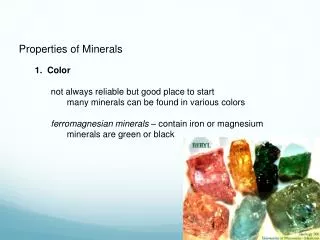
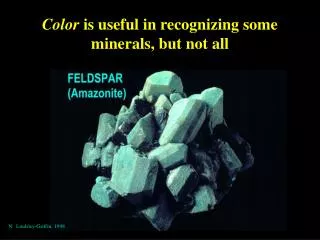
Color is useful in recognizing some minerals, but not all N. Lindsley-Griffin, 1998
Color adds value to gems N. Lindsley-Griffin, 1999
Streak, the color of the mineral’s powder,may be more useful than color in identifying a mineral N. Lindsley-Griffin, 1998
Structure of Silicate Minerals Most rocks consist of silicate minerals. The silicon-oxygen tetrahedron is the building block of silicate minerals Four oxygen ions surround a much smaller silicon ion © Houghton Mifflin 1998; Lindsley, 2000
The silicate tetrahedron consists of 4 large oxygen atoms around a smaller silicon atom Expanded View Two tetrahedrons link together by sharing an oxygen at one corner N. Lindsley-Griffin, 1999
Silicate tetrahedrons can form chains, sheets, and three-dimensional nets by sharing their oxygen atoms. Each influences mineral properties. N. Lindsley-Grifin, 1999
Tetrahedral Linkages A. Isolated tetrahedra - Olivine B. Single chain - Pyroxene C. Double chain - Amphibole D. Sheets - Micas, clay, talc E. Framework - Quartz, feldspar © Houghton Mifflin 1998. All rights reserved
Polymorphs are minerals with the same chemical composition, but different internal atomic structures CaCO3 N. Lindsley-Griffin, 1998
SUMMARY: PHYSICAL PROPERTIES of MINERALS Crystal Structure Crystal Form Interfacial Angles Habit Cleavage Fracture Hardness Luster Color Streak Specific Gravity (Density) © Houghton Mifflin 1998; N. Lindsley-Griffin, 1999. All rights reserved