Download
1 / 3
30 likes | 139 Vues
Historical examples illustrate the critical link between agricultural practices and sustainability. The environmental issues that caused societies like the Polynesian settlers of Easter Island to collapse mirror challenges we face today. Sustainable agronomy, crop science, and soil science play vital roles in ensuring food security and ecological balance. Shifting diets away from red meat and dairy to more sustainable options can significantly reduce greenhouse gas emissions. To secure a sustainable future, it’s imperative that we learn from the past and adapt our agricultural practices accordingly.

E N D
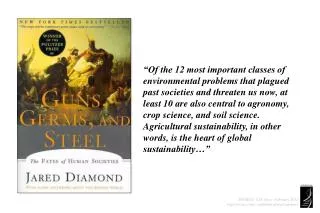
“Of the 12 most important classes of environmental problems that plagued past societies and threaten us now, at least 10 are also central to agronomy, crop science, and soil science. Agricultural sustainability, in other words, is the heart of global sustainability…” SOURCE: CSA News, February 2011 https://www.crops.org/publications/csa-news
“When a group of Polynesians arrived some 1,000 years ago on an isolated South Pacific isle known as Easter Island, they encountered a lush, forested landscape. About 700 years later, historians and anthropologists estimate the last tree was axed. Chaos ensued, and the society collapsed in a frenzy of civil war and cannibalism. The fates of failed societies carry a modern day warning: We pursue unsustainable environmental practices and ignore environmental problems at our peril.” SOURCE: CSA News, February 2011 https://www.crops.org/publications/csa-news
Shifting less than one day per week’s worth of calories from red meat and dairy products to chicken, fish, eggs, or a vegetable-based diet achieves more greenhouse gas reduction than buying all locally sourced food. SOURCE: “Local Food or Less Meat? Data Tells The Real Story”, Harvard Business Review, June 20, 2011, http://blogs.hbr.org/winston/2011/06/local-food-or-less-meat-data-t.html Weber, C.L. and Matthews, H.S. 2008. Food-miles and the relative climate impacts of food choices in the United States. Environ. Sci. Technol. 42: 3508-3513.