Option Pricing and Applications: Currency Risk and Convertible Bonds
This article discusses option pricing and its applications, specifically in the context of currency risk and convertible bonds. It covers topics such as option payoffs, valuation, Black-Scholes formula, put-call parity, and strategies for options. It also explores how fluctuations in exchange rates affect revenues and how to hedge currency risk. Additionally, it delves into the valuation of convertible bonds and the use of call options in determining their worth.

Option Pricing and Applications: Currency Risk and Convertible Bonds
E N D
Presentation Transcript
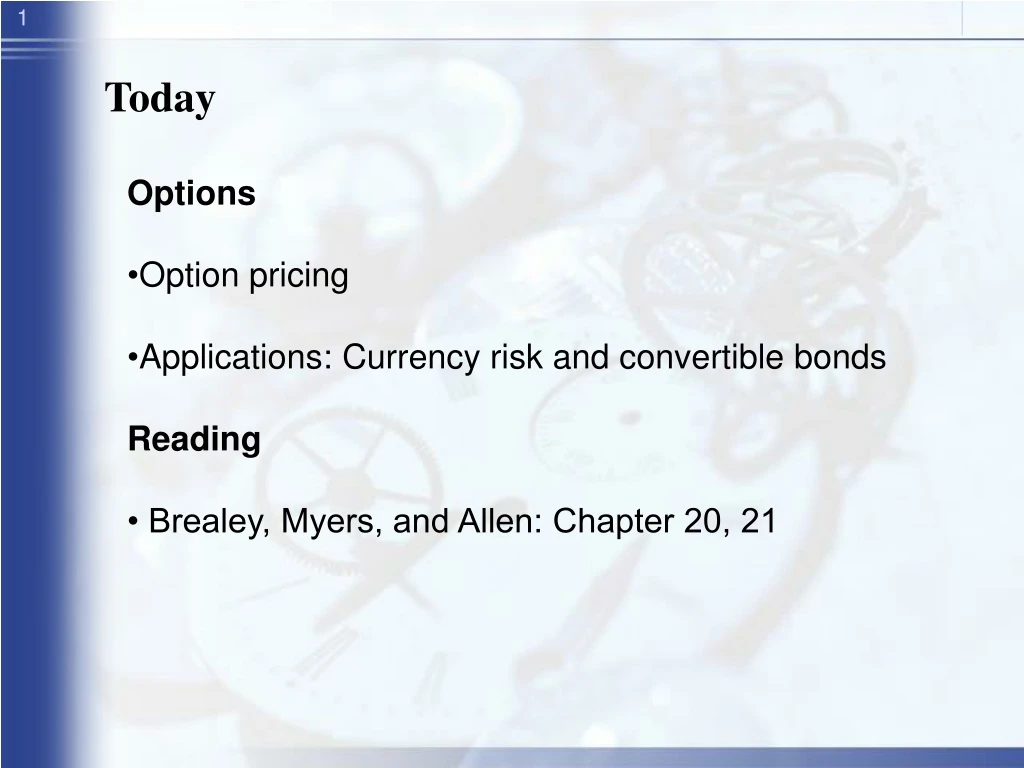
Today • Options • Option pricing • Applications: Currency risk and convertible bonds • Reading • • Brealey, Myers, and Allen: Chapter 20, 21
Options • Gives the holder the right to either buy (call option) or sell (put option) at a specified price. • Exercise, or strike, price • Expiration or maturity date • American vs. European option • In-the-money, at-the-money, or out-of-the-money
Valuation • Option pricing • How risky is an option? How can we estimate the expected cashflows, and what is the appropriate discount rate? • Two formulas • Put-call parity • Black-Scholes formula * • * Fischer Black and Myron Scholes
Option Values • Intrinsic value - profit that could be made if the option was immediately exercised (內在價值、真實價值) • Call: stock price - exercise price • Put: exercise price - stock price • Time value - the difference between the option price and the intrinsic value
Time Value of Options: Call Option value Value of Call Intrinsic Value Time value X Stock Price
Factors Influencing Option Values Factor Stock price Exercise price Volatility of stock price Time to expiration Interest rate Dividend Rate
Put-call parity • Relation between put and call prices • P + S = C + PV(X) • S = stock price • P = put price • C = call price • X = strike price • PV(X) = present value of $X = X / (1+r)t • r = riskfree rate
Put-Call Parity Relationship Long a call and write a put simultaneously. Call and put are with the same exercise price and maturity date.
Put-Call Parity Relationship ST< X ST > X Payoff for Call Owned 0 ST - X Payoff for Put Written -( X -ST) 0 Total Payoff ST - XST – X PV of (ST-X)= S0 - X / (1 + rf)T
Payoff of Long Call & Short Put Payoff Long Call Combined = Leveraged Equity Stock Price Short Put
Arbitrage & Put Call Parity Since the payoff on a combination of a long call and a short put are equivalent to leveraged equity, the prices must be equal. C - P = S0 - X / (1 + rf)T If the prices are not equal, arbitrage will be possible
Put Call Parity - Disequilibrium Example Stock Price = 110, Call Price = 17, Put Price = 5 Risk Free = 5% per 6 month (10.25% effective annual yield) Maturity = .5 yr X = 105 C - P > S0 - X / (1 + rf)T 17- 5 > 110 - (105/1.05) 12 > 10 Since the leveraged equity is less expensive, acquire the low cost alternative and sell the high cost alternative
Put-Call Parity Arbitrage ImmediateCashflow in Six Months Position Cashflow ST<105 ST> 105 Buy Stock -110 ST ST Borrow 100 X/(1+r)T = 100 +100 -105 -105 Sell Call +17 0 -(ST-105) Buy Put -5 105-ST 0 Total 2 0 0
Using Black-Scholes • Applications • Hedging currency risk • Pricing convertible debt
Currency risk • Your company, headquartered in the U.S., supplies auto parts to Jaguar PLC in Britain. You have just signed a contract worth ₤18.2 million to deliver parts next year. Payment is certain and occurs at the end of the year. • The $ / ₤ exchange rate is currently S$/₤ = 1.4794. • How do fluctuations in exchange rates affect $ revenues? How can you hedge this risk?
Convertible bonds • Your firm is thinking about issuing 10-year convertible bonds. In the past, the firm has issued straight (non-convertible) debt, which currently has a yield of 8.2%. • The new bonds have a face value of $1,000 and will be convertible into 20 shares of stocks. How much are the bonds worth if they pay the same interest rate as straight debt? • Today’s stock price is $32. The firm does not pay dividends, and you estimate that the standard deviation of returns is 35% annually. Long-term interest rates are 6%.
Convertible bonds • Call option • X = $50, S = $32, σ = 35%, r = 6%, T = 10 • Black-Scholes value = $10.31 • Convertible bond