Download
1 / 10
100 likes | 211 Vues
This lesson focuses on understanding and calculating fractions of various quantities both mentally and through effective methods. Students will learn to find a fraction of a number, practice with real examples like finding 3/4 of £2.4, and explore different approaches, such as division and conversion to decimals. They will assess the efficiency of each method, providing reasons for their choices. Students will engage in collaborative problem-solving and share their insights to deepen understanding and reinforce concepts.

E N D
Lesson Objectives: • To calculate a fraction of a number mentally. • To find a fraction of a quantity. • To choose a way of working out and give a reason why that method was chosen.
Mental starter: Using a spreadsheetto find fractions of numbers.
Lesson Objectives: • To find a fraction of a quantity. • To choose a way of working out and give a reason why that method was chosen.
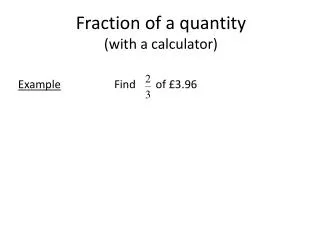
Example problem 3 of £2 4
Example problem numerator quantity 3 of £2 4 denominator
Method 1 3 of £2 4 First of all divide the quantity by the denominator of the fraction: £2 divided by 4 = 50p Next, multiply your answer by the numerator: 50p x 3 = £1.50
Method 2 3 of £2 4 First, convert the fraction to a decimal: 3/4 = 3 divided by 4 = 0.75 Next, multiply your answer by the quantity: 0.75 x £2 = £1.50
Which method is better? Why? • Is one method always better than the other?
On your white board solve these problems using both methods, discuss quietly with the person next to you which method you think is better. Be prepared to share what you’ve learnt. Work out: 1. 3/4 of £20 2. 2/3 of £180 3. 3/4 of £28 4. 2/5 of £50 5. 4/5 of £60 6. 3/8 of £80 7. 5/8 of £80 8. 4/7 of £490
Lesson Objectives: • To find a fraction of a quantity. • To choose a way of working out and give a reason why that method was chosen.