African Sleeping Sickness
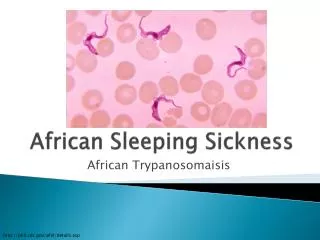
African Sleeping Sickness. African Trypanosomaisis. http://phil.cdc.gov/phil/details.asp. History. Nagana : -Zulu “To be depressed” First described in the 14 th century Noticed by slave traders who would not buy slaves displaying symptoms Trypanosomes first detected in humansin 1902.

African Sleeping Sickness
E N D
Presentation Transcript
African Sleeping Sickness African Trypanosomaisis http://phil.cdc.gov/phil/details.asp
History • Nagana: -Zulu “To be depressed” • First described in the 14th century • Noticed by slave traders who would not buy slaves displaying symptoms • Trypanosomes first detected in humansin1902. http://www.uoguelph.ca/~pwoo/animaltryp.jpg
Worked in Ubombo, South Africa with wife Mary Discovered both trypanosome and transmission by tsetse fly in 1903 ‘trypanosome fever’ = ‘sleeping sickness’ Sir David Bruce
Epidemiology • Bites of Tsetse flies, vertical, or mechanical transmission • Earliest epidemic took place between 1896 and 1906; estimated 800,000 died. • Major break outs in 1940’s and 1980’s; smaller epidemics from Senegal to Cameroon from 1920-1940’s. • Linked to droughts and political turmoil due to increase human-fly contact
Glossina/Tsetse flies http://www.medicalecology.org/diseases/d_african_trypano.htm#sect5.3
Human African Trypanosomiasis http://www.stanford.edu/class/humbio103/ParaSites2001/trypanosomiasis/trypanpo_files/image044.jpg
Trypanosoma Brucei T. brucei gambiense • West African Sleeping Sickness • Chronic, moderate symptoms with delayed onset • Represent more than 90% of sleeping sickness cases T. brucei rhodensiense • East African Sleeping Sickness • Rapid onset of severe symptoms • Intermittent fever within a few weeks
Trypanosoma brucei • Shifts from procyclic to metacyclic to trypomastigotes after exposure • Reproduction occurs through binary fission • Highly aerobic and completely dependent on host glucose for energy • Variant Surface Glycoprotein (VSG) are used to evade antibodies • shields parasitic surface proteins and transport channels • capable of shifting gene expression http://www.medicalecology.org/diseases/d_african_trypano.htm
Symptoms • Early/hemolytic stage • Bouts of fever, headaches, joint pain and itching • Caused by hemolysis due to IgM-antigen complex which binds to ethryocytes • Late/CNS stage • T. b. rhodensiense may advance within a few weeks while T. b. gambiense may take decades • Begins as the parasite crosses the blood-brain barrier resulting in confusion, sensory disturbances, poor coordination, and sleep cycle disturbances
Parasite load changes over time http://www.medicalecology.org/diseases/d_african_trypano.htm
Treatment • Stage dependent • Stage 1: Pentamidine and suramin (few side effects • Stage 2: Melarsoprol– works against both strains but has severe side effects • Eflornithine– Only works against T. b. gambiense but is much less toxic than melarsoprol. • Difficult to apply and requires strict regiment • -New Drugs on horizon
Disease Control • On the Neglected Tropical Disease list • 2000 – WHO partners with Aventis Pharma to provide treatment and free medicine to endemic countries • 2006 – Success of WHO program causes increased private partners to assist in reducing African Trypanosomiasis as a health concern • Still have limited surveillance and diagnostic abilities
Preventative Measures • Insecticides • Bush clearing • Harmful to environment • Game animal killing • Sterile male techniques • Female only mates once • Pheromone-baiting traps • Effective, cheap, nonpolluting, and trusted http://urafikikenya.com/modules/?page=photos
WHO’s 3-step disease management • Screening: Use clinical signs and/or serological assays to find at-risk individuals • Diagnose • Determine stage: Examine cerebral-spinal fluid for parasites • T. b. gambiense requires active and exhaustive screening necessary in at-risk areas • “No universal methodology”
Economic Effects • 3 million cattle die per year; over 35 million doses of trypancidal drugs administered • Under list B of the World Organization for Animal Health (OIE) • High socio-economic or health importance in countries that are significant in international trade • Most economically important livestock disease • loss of ~1 billion per year http://www.jircas.affrc.go.jp/english/publication/annual/1996/intro/images/hl_06.jpg
Bibliography • http://www.britannica.com/EBchecked/topic/401566/nagana • http://www.oie.int/eng/maladies/Technical%20disease%20cards/TRYPANO_TSETSE_FINAL.pdf • http://www.medicalecology.org/diseases/d_african_trypano.htm • http://www.whonamedit.com/doctor.cfm/871.html • http://www.ncbi.nlm.nih.gov/pmc/articles/PMC551439/ • http://www.cdc.gov/ncidod/dpd/parasites/trypanosomiasis/default.htm • http://www.who.int/topics/trypanosomiasis_african/en/ • http://www.who.int/trypanosomiasis_african/diagnosis/en/index.html • http://www.springerlink.com/content/d4jn0e3c1uypa6jl/