Skeletal Outline
Explore the skeletal system, including bone structure, functions, types, and components. Learn about the different bones, joints, and their roles in supporting the body and facilitating movement.

Skeletal Outline
E N D
Presentation Transcript
Function of Bones • Provide shape and support • Protection of internal organs • Storing minerals and fat • Producing blood cells and platelets • Assisting with movement
Bone Tissue • Composed of: inorganic salts (calcium), bone cells, blood vessels, nerves, collagen • Needs food and oxygen • Continue to grow throughout life, replacing damaged bone
Components of Bone • Osteoblasts (build up bone) • Osteoclasts (clean up bone and debris) • Cartilage • Aponeurosis • Dense (compact bone) • Spongy (cancelous bone)
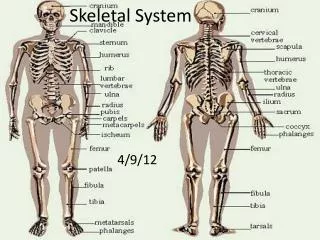
Skeletal System • Axial = 80 bones • Appendicular = 126 bones
Shapes of Bones • Long: femur, humerus, tibia, fibula • Short: small cubed-shaped: carpals, tarsals, toes • Flat: usually cover organs: scapula, pelvis, skull,ribs • Irregular: bones of ear, vertebrae, bones of face • Sesamoid: patella (knee cap)
Skull • Cranium = 8 bones • Face = 14 bones • Ears • Mandible is the only movable part of the skull
Teeth • Crown • Root • Enamel • Cementum • Dentin • Pulp • 32 teeth in an adult
Thorax • Ribs • True ribs: first 7 • False ribs: lower 5 ( last 2 are called floating ribs) • Intercostal space: contains muscles, blood vessels, nerves • Sternum • Vertebral bones = 26 bones true false
Articulations (joints) • Joints are named by the bones they join • Synarthrosis (immovable): cranial bones • Amphiarthrosis (slightly movable): ribs connected to sternum • Diarthrosis (freely movable, synovial) • Synovial joints contain a bursa: fluid filled sac
6 types of Diarthrosis(movable) Joints • Ball and socket: shoulder, hip • Hinge: elbow, ankle, knee • Gliding: in between the carpal bones • Pivot: Radius on ulna • Saddle: Thumb (thumb touching finger tips) • Gomphosis: (teeth)