The Crucible
In Act III of Arthur Miller's "The Crucible," Judge Danforth exemplifies a strict dichotomy between good and evil. He asserts that there is no neutral ground: one is either aligned with the court, representing divine order, or against it, seen as a servant of the Devil. This black-and-white worldview illuminates the irrationality of theocratic governance, where honest disagreements are impossible. The symbolism of light and dark emphasizes a Puritan belief in the absolute nature of morality, shaping Danforth's character as a relentless enforcer of perceived righteousness, dismissing complexities in human motivations.


The Crucible
E N D
Presentation Transcript
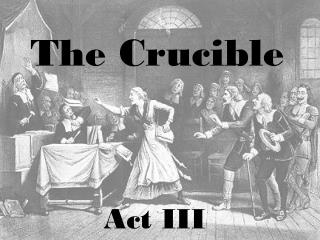
The Crucible Danforth Act III
Dichotmoy • Division into two apparently mutually exclusive and opposite parts. • i.e. Black and White, silence and noise, good and evil, East and West.
You're either with us or against us in the fight against terror."
You must understand, sir, that a person is either with this court or he must be counted against it, there be no road between. This is a sharp time, now, a precise time—we live no longer in the dusky afternoon when evil mixed itself with good and befuddled the world. Now, by God’s grace, the shining sun is up, and them that fear not light will surely praise it.
Purpose- To state Danforth’s views of right and wrong. To defend the court and its proceedings against John and Giles’ objections. • Wider theme- Relates to ideas of good and evil, also the effects of living in a theocratic society. • Symbolism- Light (They held the in their steady hands the candle that would light the world) associated with the puritan belief that they represent God’s goodness. Light = God; Dark = the Devil. Danforth is stating a view that there exists a dichotomy between god and evil; that they are two mutually exclusive ideas. This opposed to the mixing of good and evil in ‘dusky afternoon’.
What does this reveal about his character and situation: He sees the world in black and white. Everything and everyone belongs to either God or the Devil. The court and government of Massachusetts belong to God. Thus, anyone who opposes the court’s activities cannot be an honest opponent. In a theocracy, one cannot have honest disagreements because God is infallible. Since the court is conducting the witch trials, anyone who questions the trials is the court’s enemy. From there, the logic is simple: the court does God’s work, and so an enemy of the court must, necessarily, be a servant of the Devil.