Download
1 / 5
50 likes | 165 Vues
This piece discusses the application of hypothesis testing in evaluating the operational performance of wastewater treatment facilities. It includes practical examples, starting with a case study of a facility monitoring BOD5 levels, where a significant difference from the historical mean indicates potential operational issues. Additional examples highlight comparison of two groups and testing for equal variances using T-tests and F-tests, revealing insights into data analysis in environmental monitoring and wastewater management.

E N D
Some uses of hypothesis testing Practical example
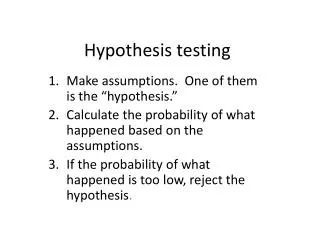
Example 1 – Performance of Wastewater Treatment plant • A lengthy history of monitoring records from a wastewater treatment facility has established that the long-term population mean for BOD5 is 12mg/L. Current operational characteristics over the last weeks of sampling have resulted in the following BOD5 concentrations in the effluent stream: 14.6, 12.8, 13.7, and 15.4. Do to the current operating characteristics suggest an operational problem in the wastewater stream facility. • we need to test if the difference between the historical mean and the sample mean is significant (check if sample mean is much more the population mean) • Use T-Test • X_bar = 14.1 • S = 1.12 • tc = 2.353 for df=3 and 0.05 significance level • The results indicates a significant difference in the mean operating characteristics of the treatment facility
Example 2 – comparing two groups of results • The monitoring record of BOD (all value is mg/L) in the outfall for a wastewater treatment facility listed the following results: October 1994 12, 11,14,7 November 1994 8, 9,6,13 Are concentrations in October larger (statistically significant) that average concentrations for November at five percent level of significance? • Use T-Test • X1 = 11 and X2 = 9 • S1 = 2.94 and S2 = 2.94 • tc = 1.95 for df=8-2=6 and 0.05 significance level • The results indicates insufficient evidence for significant difference between Oct and Nov results
Example 3 – Effect of Unequal VariancesF-test • Benzene concentrations were measured at two monitoring well locations (MW1 and MW2) as listed in the table below. Are the variances measurements at two monitoring locations significantly at the five percent level of significance? • Use F Test to test if the difference is significant ? • Df (large sample) = 11 • Df (small sample ) = 11 • F test (from the tables) = 2.9 • F ratio < F test • No significant difference