The Art and Science of Classification: Understanding Aristotle to Linnaeus
This text explores the evolution of biological classification from Aristotle’s early attempts to arrange living organisms into plants and animals, to Carolus Linnaeus's modern system. Discover how Linnaeus's innovative taxonomy established seven hierarchical groupings—Kingdom, Phylum, Class, Order, Family, Genus, and Species—enabling scientists to systematically categorize and communicate about life forms. The significance of binomial nomenclature and the distinction between prokaryotes and eukaryotes are also discussed. Gain insights into the complexity and order of the living world.

The Art and Science of Classification: Understanding Aristotle to Linnaeus
E N D
Presentation Transcript
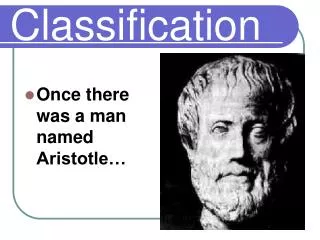
Classification • Once there was a man named Aristotle…
He was a very smart man who like orderly things (sometimes scientists are like that.)
The world, however, was not orderly. All these random living things…it was a mess! • So…he decided to do something about it.
Then, he had a stroke of genius. He got even more specific and grouped all plants into…
Animals were split into Animals of the air…
Notice any problems? • What about frogs, both land and water?
Enter Carolus Linneaus, 2000 years later. He liked things orderly, also. Invented the modern classification system
He wrote a book and decided to group living things in a different way. He grouped living things based on their STRUCTURAL SIMILARITIES.
He grouped similar groups into larger groups, until he had seven groupings.
The Seven Taxons(Groupings): • Kingdom • Phylum • Class • Order • Family • Genus • Species
Classification of Humans • Kingdom: animal • Phylum: chordate • Class: mammal • Order: primate • Family: hominid • Genus: Homo • Species: sapien
Taxonomy(Systematics) – science of grouping and naming things • Scientists classify organisms and assign each organism a universally accepted name • Why? By using a scientific name, scientists can be sure everyone is discussing the same organism • Lepus arcticus
How specific does it go? • Linneaus’ smallest grouping was called the species-reproduce with each other.
Genus- a group of similar species • He grouped similar species into a larger grouping called genus.
Binomial Nomenclature • GENUS + SPECIES = Scientific name! • Examples: • Homo sapien • Acer rubrum • Drosophilia melanogaster • Felis concolor • Felis domesticus
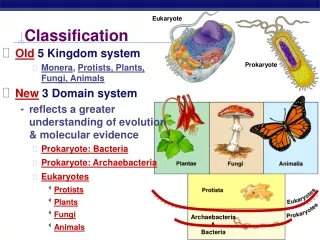
Prokaryotes- simple cells Eubacteria- “normal” bacteria found everywhere Archaebacteria- unusual bacteria found in hot springs, brine pools and mud Eukaryotes- complex cells with nucleii Fungus- mold, mushrooms, etc. decomposers Protists- microscopic “left over” group Plants- make food Animals- consumers of food Today’s Modern Kingdoms 2 1
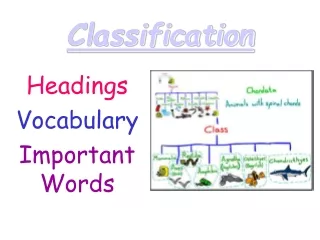
Classification • Cladogram (Phylogenetic tree)- diagram showing the evolutionary relationships among a group of organisms.