The Reconstruction Era in Illinois: Progress, Challenges, and the Rise of Industry
The Reconstruction Era marked a pivotal time in Illinois following the Civil War, impacting millions of newly freed slaves. Under President Johnson, Southern states enacted stringent laws against African Americans while Republican-led policies began in 1867, ensuring voting rights for Black citizens. The emergence of groups like the Ku Klux Klan sought to undermine these efforts. Concurrently, Illinois experienced rapid industrial growth, urbanization, and the establishment of significant labor movements, culminating in a transformative period characterized by political corruption, devastating events like the Great Chicago Fire, and a burgeoning economy.

The Reconstruction Era in Illinois: Progress, Challenges, and the Rise of Industry
E N D
Presentation Transcript
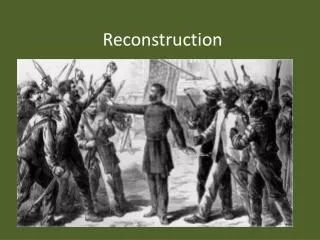
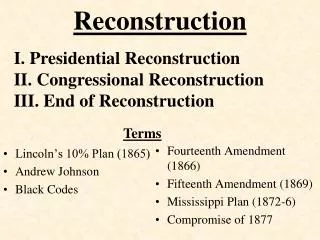
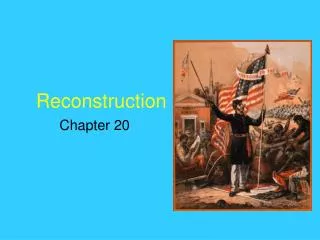
Reconstruction • 4 Million slaves now free • President Johnson – southerner • South passes strict laws against African Americans • “Radical” Reconstruction begins in 1867. • Republicans force the south to allow African Americans the right to vote.
The Rise of the Ku Klux Klan • 1866 - Social Club • Ex-Confederate Officers • Ritualistic • Oppose Reconstruction efforts • Terrorize blacks and black sympathizers • Power declines over 1870s
Modernizing Illinois Illinois History
Morrill Act of 1862 • Every loyal state receives 30,000 acres of public land for each Congressman they have • Illinois – 480,000 acres • Sell land to fund university • University of Illinois [1885] Justin Smith Morrill, Senator - Vermont
New State Capitol • 1865 – Chicago, Peoria, Decatur, and Jacksonville put in bids to become the new state capitol. • Springfield offers tax money to build a new capitol building. • Capitol stays in Springfield.
New Constitution • Hold a convention • More Republicans • More delegates with northern backgrounds • More attorneys than farmers • Ratified in 1870 • Denies suffrage to women
Republican Control • “waving the bloody shirt” • Controlled the Assembly for last quarter of the 19th century • Every governor from 1865-1892 • Only 1 Democrat senator from 1865-1912
Illinois and the “Gilded Age” • Corrupt politicians and lobbyists • Experiencing significant industrial growth • By 1890, only 1/3 of workforce in agriculture
The Great Chicago Fire • Date: October 9th, 1871 • Catalysts: Chicago being mainly wood, recent drought, lack of firemen • Result: • Watertower only building to survive • 300 dead • 100,000 homeless • Chicago rebuilds
New Chicago Rises • Lumber yards, railroads, and stockyards survive fire. • First modern skyscraper • Home Insurance Building [1884] • Cast-iron frame • Many more to follow • Chicago’s population nearly doubles in 1870s • More than St. Louis by 1880
Stockyards – “Packingtown” • 100 acres of land – 2,300 pens • 21,000 cattle, 22,000 sheep, 200 horses • All at once. • Nelson Morris – German immigrant who supplies beef to U.S. Army during the Civil War • Gustavus F. Swift • Phillip D. Armour • “Everything but the squeal”
Recap • McCormick’s reapers pioneer the use of advertising and credit • Takes hold of lumber market • Hub of railroads and grain production
Department Stores • Potter Palmer, Marshall Field, Sears and Roebuck establish huge department stores. • Mail order catalog originates in Chicago • Montgomery Ward • Huge catalogs (1,000 pages)
Other Industrial Growth • Areas around Chicago also develop industry • Metro East St. Louis develops significant iron and steel industries • Granite City • East St. Louis • Belleville • Alton • 1900 – ¼ of liquor comes from Peoria • Leads to a population boom
Organizing Labor • Nation’s first coal miners union organizes in West Belleville, Ill. • Unions push for shorter work day, better pay, limitation of child labor, equal pay for both sexes
Haymarket Square [1886] • Anarchists meet in the square to demand better conditions. • Police attempt to disperse crowd • Bomb explodes, police open fire on the crowd • 7 policemen dead, 4 others. • 4 hanged at trial although no connection was made between them and bomber
Haymarket Square Memorial Forest Park, Ill.
Frank Lloyd Wright • B. June 8th, 1867 • D. April 9th, 1959 • Architect • Prairie Style Architecture • Wanted to build structures in harmony with nature and their surroundings