An Improved Search Algorithm for Optimal Multiple-Sequence Alignment
This paper presents an enhanced search algorithm aimed at optimizing multiple-sequence alignment (MSA). The study explores various heuristics for computing path costs while utilizing graph representation for effective alignment. The paper covers DNA and protein sequences, delving into the challenges of insertion, deletion, and point mutations in alignment. The experimental results demonstrate the efficacy of the proposed methods over existing techniques. Key applications include assessing common ancestry between species, identifying functional DNA segments, and predicting protein structures, emphasizing the biological implications of alignment efficiency.

An Improved Search Algorithm for Optimal Multiple-Sequence Alignment
E N D
Presentation Transcript
An Improved Search Algorithm for Optimal Multiple-Sequence Alignment • Paper by: Stefan Schroedl • Presentation by: Bryan Franklin
Outline • Multiple-Sequence Alignment (MSA) • Graph Representation • Computing Path Costs • Heuristics • Experimental Results • Other Optimizations
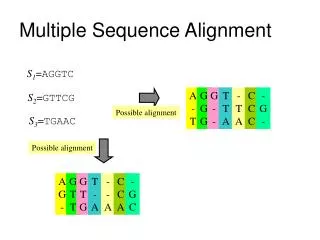
Multiple-Sequence-Alignment • Sequence: • DNA: String over alphabet {A,C,G,T} • Protein: String with |Σ|=20 (one symbol for each amino acid) • Alignment: • Insert gaps (_) into sequences to line up matching characters.
Multiple-Sequence-Alignment Sequences: ABCB, BCD, DB
Multiple-Sequence-Alignment • Indel: Insertion, Deletion, Point mutation (single symbol replacement) • Find a minimum set of indels between two or more sequences. • NP-Hard for an arbitrary number of sequences
Multiple-Sequence-Alignment • Applications • Common ancestry between species • Locating useful portions of DNA • Predicting structure of folded proteins
Computing G(n) • Considerations • Biological Meaning • Cost of computation • Sum-of-pairs • Substitution matrix ((|Σ|+1)2) • Sum alignment costs for all pairs • Costs can depend on neighbors
Computing G(n) Sequences: ABCB, BCD, DB
Computing G(n) 7 7 8 7 6
Heuristics • Methods Examined • 2-fold (hpair) • divide-conquer • 3-fold (h3,all) • 4-fold (h4,all)
Optimizations • Sparse Path Representation • Curve fitting for predicting threshold values • Sub-optimal paths periodically deleted
The End • Any Questions?