Understanding Key Elements of Page Design in Journalism
130 likes | 266 Vues
This article delves into essential elements of page design commonly used in journalism. It covers the main title, subheadings, cutlines, photo credits, bylines, and datelines, providing an overview of their significance and purpose. It also explains concepts like the lead story, dominant and secondary art, nameplates, and folios, which contribute to effective page layouts. This insight is crucial for aspiring journalists and editors aiming to enhance their understanding of media presentation and communication.


Understanding Key Elements of Page Design in Journalism
E N D
Presentation Transcript
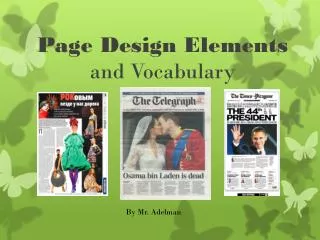
Page Design Elementsand Vocabulary By Mr. Adelman
Headline • The main title of an article
Subhead • A smaller headline that adds information to the main headline.
Cutline • A caption that gives information about a photograph.
Photo Credit • Small text that identifies the photographer
Byline • Text that identifies the author of an article.
Dateline • Text that identifies the city where an article was reported. ALL CAPS
Jump Line • Text that tells a reader where an article continues. (Example: Please turn to page 2)
Lead Story • The biggest and most important article on a page. Usually news.
Dominant Art • The biggest photo or graphic on a page
Secondary Art • The second-biggest photo or graphic on a page
Nameplate • Text or graphic that identifies the name of a publication
Folio • Text that identifies the date, volume, and issue of a publication