Electrons & light
This section delves into the nature of electromagnetic energy, focusing on its wave properties, such as frequency and wavelength. It outlines the fundamental concept that all electromagnetic radiation, from radio waves to x-rays, travels at approximately 300,000 kilometers per second in a vacuum. The relationship between frequency and wavelength is explored, emphasizing their inversely proportional nature. Sample problems, including calculations of wavelength for given frequencies, provide practical applications of these concepts. Understanding these principles is essential in fields like physics and engineering.

Electrons & light
E N D
Presentation Transcript
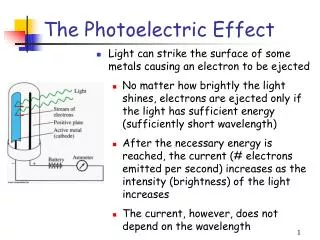
Electrons & light The duel nature of electrons Book reference: Chapter 13 pages 372 - 375 Question 11 & 12
Electromagnetic Energy • Energy transferred in the form of waves • All electromagnetic radiation -- from radio waves to x-rays -- travel at the speed of light. In empty space this speed is approximately 300,000 kilometers per second! 3.0 x 10⁸ m • Wave shape and mechanics http://id.mind.net/~zona/mstm/physics/waves/partsOfAWave/waveParts.htm sine wave wavelength frequency amplitude
Frequency & wavelength • The relationship between frequency and wavelength define the type of energy • These two variables are inversely proportional • High frequency (n): small wavelength (l) • The constant is light speed (C), so • C = n x l
Units • Frequency = cycles per second • Cycles/second = 1/sec = sec-1 = hz (most used) • Wavelength in meters or nanometers • Light speed m/sec , cm/sec • Be careful and watchful of units make sure they match
C = n x l Find the wavelength of energy if the frequency is 2.4 x 10¹⁴ hz Find the wavelength of the radio wave, FM 102 3.0 x 10⁸m/sec/2.4 x 1014hz 1.3 x 10⁻⁶ m 3.0 x 10⁸m/sec/1.02 x 108hz 2.94 m Sample Problems