
SlideServe
Menu
Préférences
© SlideServe · v2026

Transforming STEM Education: A Collaborative Approach for Inclusive Innovation

hamish-bryan avatar
6 diapositives · 203 Views · Oct 31, 2014

This proposal outlines a comprehensive plan to enhance STEM education through collaboration with diverse organizations, innovative ideas, and strong evaluation and dissemination strategies. It addresses key strengths and weaknesses for effective implementation.
Transforming STEM Education: A Collaborative Approach for Inclusive Innovation - slide 1
01 / 6Transforming STEM Education: A Collaborative Approach for Inclusive Innovation
1 / 17

Télécharger la présentation

Transforming STEM Education: A Collaborative Approach for Inclusive Innovation
Une image / un lien ci-dessous est fourni (tel quel) pour télécharger la présentation

Politique de téléchargement : le contenu du site vous est fourni TEL QUEL pour votre information et votre usage personnel ; il ne peut être vendu, concédé sous licence ni partagé sur d’autres sites sans l’accord de son auteur.Le contenu vous est fourni TEL QUEL, pour votre information et votre usage personnel uniquement. Téléchargez la présentation en cliquant sur ce lien. Lors du téléchargement, si vous ne parvenez pas à télécharger une présentation, l’éditeur a peut-être supprimé le fichier de son serveur.Pendant le téléchargement, si vous ne parvenez pas à obtenir une présentation, le fichier a peut-être été supprimé par l’éditeur.

F I N

Plus de contenu associé

Transcription de la présentation
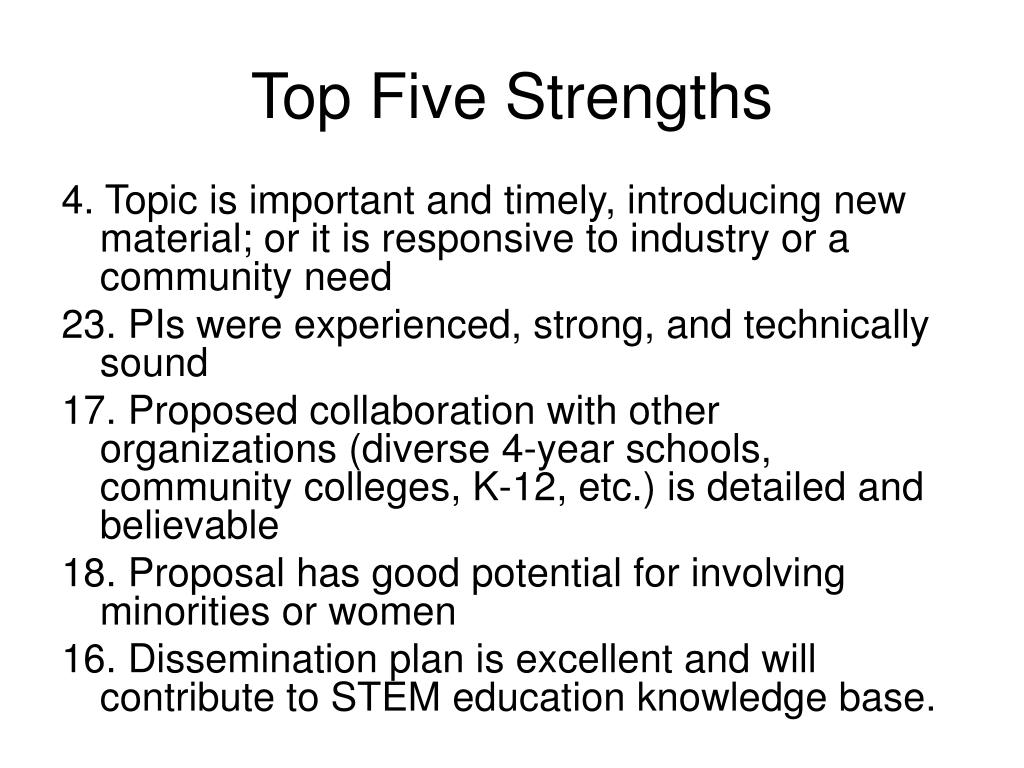
  1. Top Five Strengths 4. Topic is important and timely, introducing new material; or it is responsive to industry or a community need 23. PIs were experienced, strong, and technically sound 17. Proposed collaboration with other organizations (diverse 4-year schools, community colleges, K-12, etc.) is detailed and believable 18. Proposal has good potential for involving minorities or women 16. Dissemination plan is excellent and will contribute to STEM education knowledge base.

  2. Second Five Strengths 3. Proposed ideas are likely to have a large impact (Number of students, broadness of idea, etc.) 7. Proposed ideas build on prior work or existing products 13. Evaluation plan is excellent, outstanding, or good 2. Proposed ideas are novel or innovative 10. Proposed activities include non-traditional pedagogy.

  3. Top Five Weakness 9. Proposed activities are described in insufficient detail without clear plans. 13. Evaluation plan is weak or incomplete, or lacking 8. Proposed activities are not doable and will not result in expected outcomes. 16. Dissemination plan is weak, incomplete, or lacking or project will not contribute to STEM education knowledge base. 18. Proposal has no or limited potential for involving minorities or women

  4. Second Five Weakness 7. Proposed ideas do not build on prior work or existing products 2. Proposed ideas are not novel or innovative 3. Proposed ideas are not likely to have a large impact (Number of students, broadness of idea, etc.) 17. Proposed collaboration with other organizations (diverse 4-year schools, community colleges, K-12, etc.) is not detailed or believable 4. Topic is not important or timely, does not introduce new material; or is not responsive to industry or a community need

  5. Top Ten Strengths and Weaknesses

  6. Proposal Section Addressing Strength and Weaknesses Use G (Goals), R (Rational), M (Methods), or P (Plan)