Understanding Conditional Probabilities: Legal Case Study
Explore the Prosecutor’s Fallacy through the People vs. Collins case study, highlighting the confusion in conditional probabilities and lack of evidentiary foundation in legal reasoning.

Understanding Conditional Probabilities: Legal Case Study
E N D
Presentation Transcript
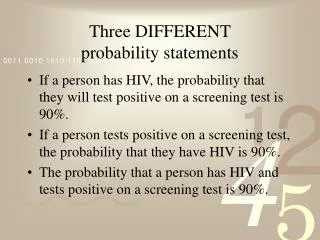
Three DIFFERENTprobability statements • If a person has HIV, the probability that they will test positive on a screening test is 90%. • If a person tests positive on a screening test, the probability that they have HIV is 90%. • The probability that a person has HIV and tests positive on a screening test is 90%.
Conditional Probability P(A|B) Event of interest Conditioning Event “Given” The probability that A occurs given that B occurs
Confusing conditional probabilitiesThe Prosecutor’s FallacyA case study: People vs. Collins • On June 18, 1964, Juanita Brooks was attacked in an alley near her home in LA and her purse stolen • A witness reported that a woman running from the scene was blond, had a pony tail, dressed in dark clothes and fled from the scene in a yellow car driven by a black man with a beard and mustache • Police arrested a couple, Janet and Mark Collins, which fit the description
People vs. Collins • During 7-day trial, prosecution ran into difficulties • Juanita Brooks could not identify either defendant • Witness admitted at a preliminary hearing that he was uncertain of his identification of Mr. Collins in a police lineup • Math instructor at a state college took the stand as an expert witness • Was asked, “What is the chance that Mr. and Mrs. Collins are innocent given that they match the descriptions of the perpetrators on all six characteristics?” • The expert witness testified that the probability of a combination of characteristics, or their joint probability, is given by the product of their individual probabilities
People vs. Collins • The prosecution provided the following probabilities • Prosecution multiplied these probabilities to claim that the probability that a randomly selected couple would have all these characteristics was 1 in 12 million • Prosecutor concluded that the chance that the defendants were innocent was only 1 in 12 million • The jury convicted the Collinses of second-degree robbery.
People vs. Collins • Defense appealed and the California Supreme Court reversed the conviction on four grounds: • The probabilities lacked “evidentiary foundation.” They were merely estimates. • Multiplying the six probabilities assumes independence, for which there is no proof • The prosecutor assumed that the six characteristics were certain • Most importantly, there was a fundamental flaw in the prosecutor’s reasoning
The Prosecutor’s Fallacy • Prosecution inferred that the probability of observing a match in all six characteristics is the probability that the Collinses were innocent. • This is known as the prosecutor’s fallacy • P(Match) ≠ P(Innocent | Match) • Suppose the match probability was correct • Suppose the reference population is 24 million couples in California and one of them is guilty • If P(Match) = 1/12 million, we would expect two couples to match • P(Innocent | Match) = P(Innocent and Match) / P(Match) = (1/24 million) / (1/12 million) = 1/2