Contraception and STDS
Explore the essential contraception and sexually transmitted disease (STD) services offered by the Department of Fertility Care at St. John’s Mercy Medical Center. Understand various contraception methods including barrier methods, hormonal treatments, IUDs, and sterilizations, along with their effectiveness and possible side effects. Learn about common STDs such as HIV, syphilis, and HPV, their impacts, and the importance of prevention and treatment options. Empower yourself with knowledge for better reproductive health.

Contraception and STDS
E N D
Presentation Transcript
Contraception and STDS Department of Fertility Care Services St. John’s Mercy Medical Center
Contraception • Against or prevention of conception occurring. • Prevention of sperm and egg uniting • Disrupting the natural process of fertilization, implantation, or uterine preparation to receive a new life.
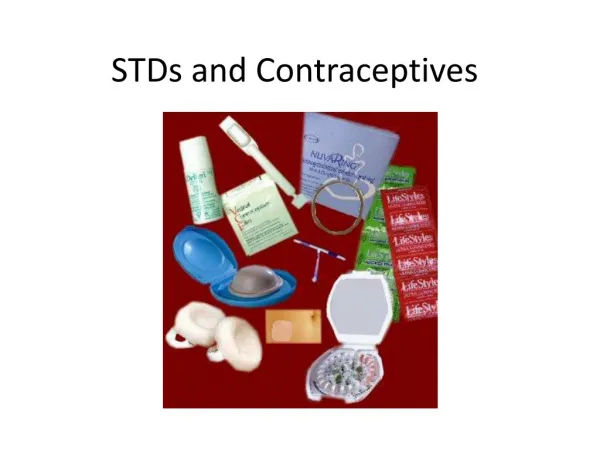
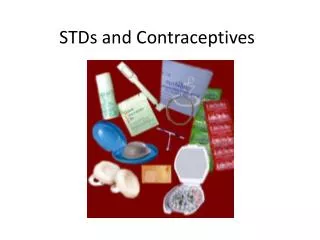
Types of Contraception • Barrier Methods • Hormonal Rings • Birth Control Pills or OCPs • Intrauterine Devices (IUDS) • Sterilizations
Barrier Methods • Condoms • Foams • Sponges • Diaphragms
Possible Side Effects • Allergic Reactions and Irritation • Diaphragm sometimes difficult to removal • Increase Risk of Toxic Shock Syndrome
Effectiveness of Barrier Methods • Actual 96.8% • Continual % after one year of use 89%
Hormonal Methods • Hormonal Rings-Nuva-Ring • Birth Control Pills or OCPs • Hormonal Patches
Possible Side Effects • May delay return of normal fertility. • Breast problems • Depression • Weight gain • Headaches • Nausea and Vomiting • Irregular bleeding
Effectiveness • Actual 94% • Continuation % after one year of use 72%
Intrauterine Devices • IUDs • Copper • Mirena
Possible Side Effects • Heavy, irregular or painful menses • Painful intercourse • Infection • Ectopic pregnancy • Perforation of the uterus • Infertility
Effectiveness • Actual 97% • Continuation % after one year of use 80%
Sterilizations • Tubal Ligation • Essure • Vasectomy
Possible Side Effects • Risk of bleeding or infection with operations • Increased rates of hysterectomy, ectopic pregnancy • Painful periods • Two-fold increase in rate of prostate cancer
Effectiveness • Tubals Actual 99.6% • Vasectomies 99.8% • Continuation% after one year of use 100%
Sexually Transmitted Diseases STDsorSexually Transmitted InfectionsSTIs
STIs • Infections of the genital tract of male or female which can be transmitted back and forth through the genital contact
Types of STIs • Syphilis and Gonorrhea-Pre 1960 • Chlamydia- 1976 • HIV and AIDS-1981 • Genital Herpes-1982 more prevalent • Pelvic Inflammatory Disease- 1992 • Human Papillomavirus (HPV) 1996
Types of STIs • Hepatitis B • Bacterial Vaginosis (BV) • Trichomoniasis
Gonorrhea • Contracted through sexual contact bacterial • Symptoms Discharge containing pus Burning and frequency of urination
Affects to Fetus • Affect the eyes by causing blindness • Sores on the scalp • Joint infections or other infections
Syphilis • Contracted through sexual contact-bacterial-very contagious and increase risk of contracting HIV infection • A pregnant mother can transmit to her unborn child
Affects to Fetus • Can cause stillbirth or baby may die soon after birth. • Developmental delays • Seizures or die
Symptoms • A chancre (“shanker”) usually firm and painless but highly contagious usually appear 3 weeks after exposure • If left untreated progresses to Severe brain damage, heart, blood vessel damage.
Chlamydia • Most common nonviral STI in US • Major cause of pelvic inflammatory disease (PID), ectopic pregnancy, pelvic pain, and infertility in women • Can cause no discomfort or vaginal discharge, pain and fever.
HIV and AIDS • 1981 discovered-Virus • HIV infection usually results in AIDS • AIDS is a potentially fatal disease • Once HIV-infected, most individuals contagious for the rest of their lives. • Can be contracted from one act of intercourse with HIV-infected person,
People at Risk of Contracting • Newborns of mothers with HIV, • Health-care workers with needle sticks, Drug users who share needles • Sexual partners with virus who have sex with a male or female
Herpes • Two types- Herpes Simplex 1 or 2 (HSV) • Really doesn’t matter on type because infections both cause blisters • Can be silent with symptoms that still can shed the virus between partners.
Symptoms • Fever blisters on lips or mouth usually HSV 1, but can be HSV 2 too • Genital Herpes- Predominantly HSV 2 cause reoccur ant painful blisters • Triggers of outbreaks can be stress, illness, menstrual cycles
Herpes and Birth of Baby • Mothers with virus who have outbreak during labor and delivery can pass virus onto infant and is usually fatal to infant. • Medication can suppress outbreaks and is safe during last month of pregnancy.
Pelvic Inflammatory Disease • Commonly known as PID • Can result from some of the STIs • Gonorrhea, Chlamydia • Scars fallopian tubes leading to infertility, ectopic pregnancy, pelvic pain, painful intercourse
Hepatitis B • Viral infection with severe complications • Can cause chronic hepatitis, cirrhosis and liver cancer. • Appr. ½ of infections transmitted through sexual intercourse. 1/3 had another STD • Pregnant mother can pass to fetus and infectious carriers
Human Papillomavirus (HPV) • Major cause of abnormal pap smears and cause of cervical cancer • One of the most common cancers in women • Virus transmitted through sexual contact with peak prevalence in women ages 22-25.
Bacterial Vaginosis and Trichomoniasis • BV left untreated can lead to PID • Strongly associated with preterm births • Both vaginal infections increase risk of HIV infection if come in contact • All women with any STIs diagnosed should be screened for all STIs.