Comprehensive Patient Referral Data Classification for Healthcare Providers
This document outlines the essential data classification necessary for patient referral requests, adhering to MU2 and CCDA requirements. It covers patient demographics, identifiers, and referral administrative information, including insurance details and provider information. It emphasizes the importance of excluding sensitive information like SSN and provides guidelines on the clinical data to include, such as reasons for referral, medications, laboratory results, and vital signs. Ensuring accurate and compliant data exchange between referring and receiving providers is critical for effective patient care.

Comprehensive Patient Referral Data Classification for Healthcare Providers
E N D
Presentation Transcript
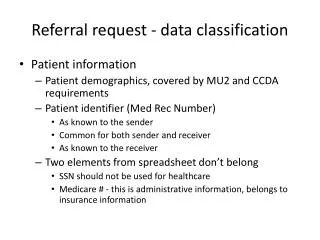
Referral request - data classification • Patient information • Patient demographics, covered by MU2 and CCDA requirements • Patient identifier (Med Rec Number) • As known to the sender • Common for both sender and receiver • As known to the receiver • Two elements from spreadsheet don’t belong • SSN should not be used for healthcare • Medicare # - this is administrative information, belongs to insurance information
Referral request - data classification • Referral administrative information • Referral Identifier (not present in the spreadsheet) • Referral Date • Time period in which referral is expected to occur • Referral Approval obtained • Insurance pre-authorization, if necessary (e.g. Yes/No, number) • Insurance information (multiple insurance policies/kinds possible) – usually covered in ADT or X12 messages • Kind (primary, secondary, Medicare/Medicaid, Worker’s comp) • Policy number • Group number • Insurance member ID (e.g. Medicare #) • Guarantor/Subscriber/Insured demographics
Referral request - data classification • Referring provider (sender) information • Receiving provider information • Patient’s PCP and care team (if different from sender and receiver) • Information provided by provider directories • Provider identifier • Direct address • NPI # • Provider demographics • Provider organization
Referral request - data classification • Clinical information • Reason for referral • Referring or transitioning provider's name and office contact information • MU2 specified clinical information • Problems (SNOMED-CT value set) • Medications (RxNorm) • Medication allergies (RxNorm) • Laboratory test(s) (LOINC) • Laboratory value(s)/result(s) • Vital signs (height, weight, blood pressure, BMI) • Care plan field(s), including goals and instructions • Procedures (SNOMED-CT or HCPCS/CPT-4), optional CDT, optional ICD-10-PCS • Care team members, including the PCP • Encounter diagnosis (ICD-10-CM or SNOMED-CT) • Immunizations (HL7 Standard Code Set CVX) • Functional status, including activities of daily living, cognitive/disability status • Additional clinical information (depending on specialty)