Download
1 / 10
100 likes | 254 Vues
The Simple Fractured Reservoir Screening Tool is designed to help identify fractured reservoirs by evaluating specific indicators. If you answer "Yes" to any key questions—such as unusual permeability rates, variable well outputs, or unexpected fluid influx—this tool provides critical insights. Utilizing geological data, well tests, and advanced modeling techniques, it enables effective assessment and management of fractured reservoirs across various stages of exploration, production, and recovery, ensuring optimal resource extraction and risk management.

E N D
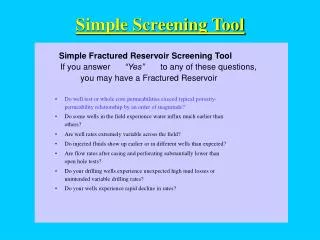
Simple Fractured Reservoir Screening Tool If you answer “Yes” to any of these questions, you may have a Fractured Reservoir • Do well test or whole core permeabilities exceed typical porosity- permeability relationship by an order of magnitude? • Do some wells in the field experience water influx much earlier than others? • Are well rates extremely variable across the field? • Do injected fluids show up earlier or in different wells than expected? • Are flow rates after casing and perforating substantially lower than open hole tests? • Do your drilling wells experience unexpected high mud losses or unintended variable drilling rates? • Do your wells experience rapid decline in rates? Simple Screening Tool
Cores Borehole Image Logs 2-D Seismic Core Analysis (Plug, Whole Core/3-D Whole Core) Structural/Fracture Modeling Single & Multiple Well Tests Tracer Tests 3-D Seismic History Matching Reservoir Simulations Directional Permeability Data Water Breakthrough 4-D Seismic Drainage Area Calculations (Access, Production, Harvest) Data Types Useful in Fractured Reservoir Analyses
Procedures When “Discovered” During1) Exploration/Access • Obtain cores and/or image logs in all early wells • Predict natural fracture distributions • Select optimum well locations and well paths • Determine and map in situ stress from breakouts, etc.. • Determine fractured reservoir type • Evaluate reserves, variability, and risk
Procedures When “Discovered” During2) Primary Recovery/Production • Plan static data collection wells • Perform multiple well tests • Model fracture system and in situ stress and correlate with dynamic data • Determine directional permeability vectors • Correlate fracture directions, in situ stress, and directional permeability • Refine reservoir simulations using fractures
Procedures When “Discovered” During3) Secondary Recovery/Harvest • Re-evaluate flood patterns • Evaluate water production in terms of fractures • Model in situ stress across the field • Infer characteristics of the fracture system from dynamic data • Re-evaluate reservoir simulations to include fracture anisotropy • Revise predicted recovery factor (down)