

SlideServe
Menu
Préférences
© SlideServe · v2026

Apartheid:

harken avatar
9 diapositives · 915 Views · Jul 30, 2014

A System for Legalizing Racism . Apartheid:. Objectives. What was the purpose of apartheid? How did apartheid affect the lives of South Africans? Why did South Africa move toward democracy?. The Republic of South Africa…. South African Geography…. What is Apartheid?.
Apartheid: - slide 1
01 / 9Apartheid:
1 / 17

Télécharger la présentation

Apartheid:
Une image / un lien ci-dessous est fourni (tel quel) pour télécharger la présentation

Politique de téléchargement : le contenu du site vous est fourni TEL QUEL pour votre information et votre usage personnel ; il ne peut être vendu, concédé sous licence ni partagé sur d’autres sites sans l’accord de son auteur.Le contenu vous est fourni TEL QUEL, pour votre information et votre usage personnel uniquement. Téléchargez la présentation en cliquant sur ce lien. Lors du téléchargement, si vous ne parvenez pas à télécharger une présentation, l’éditeur a peut-être supprimé le fichier de son serveur.Pendant le téléchargement, si vous ne parvenez pas à obtenir une présentation, le fichier a peut-être été supprimé par l’éditeur.

F I N

Plus de contenu associé

Transcription de la présentation
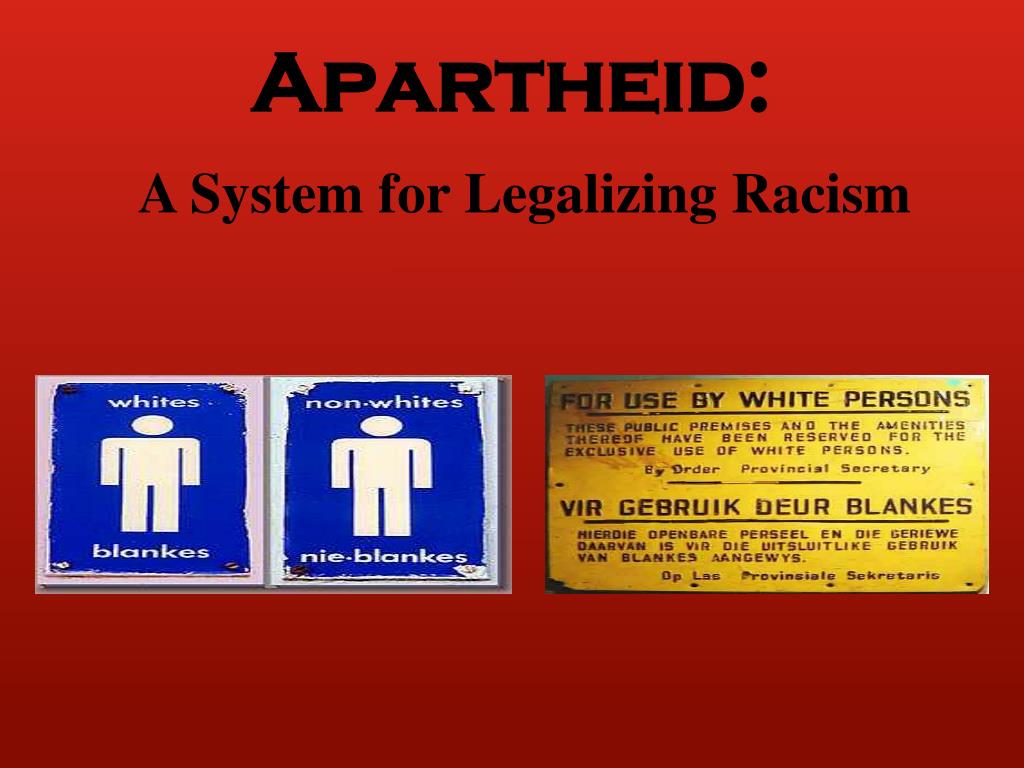
  1. A System for Legalizing Racism Apartheid:

  2. Objectives • What was the purpose of apartheid? • How did apartheid affect the lives of South Africans? • Why did South Africa move toward democracy?

  3. The Republic of South Africa…

  4. South African Geography…

  5. What is Apartheid? • Apartheid – A strict legal system or rigid separation of races. • Under apartheid, the government classified all South African’s as White, Black, “Colored” (people of mix race), or Asian.

  6. South African Statistics…

  7. Government Sanctions • Natives (Urban Areas) Act, 1923 Deemed urban areas in South Africa as "white" and required all black African men in cities and towns to carry permits called "passes" at all times. • Natives (Urban Areas) Consolidation Act, 1945Imposed essentially the same restrictions. • Natives (Abolition of Passes and Co-ordination of Documents) Act, 1952. This law provides more details of the individuals carrying the “pass.” • Think about what the effects would be on the part of society whom these laws apply.

  8. Resistance to Apartheid • In 1912 the South African Native National Congress (in 1923 it was renamed the African National Congress, ANC) was founded by a group of black urban and traditional leaders who opposed the policies of the first Union of South Africa government, especially laws that appropriated African land. • During the 1950’s the ANC dramatically increased its membership under the leadership of Albert Luthuli and Nelson Mandela who became one of the organization’s principal organizers in response to the obtrusive laws of Apartheid. • In the late 1960s Stephen Biko and other black students founded the Black Consciousness Movement (BCM), which was loosely based on the Black Power movement in the United States. • The Pan Africanist Congress (PAC) was formed in April 1959, with Robert MangalisoSobukwe as president.

  9. The Legacy of Apartheid…