Download
1 / 12
120 likes | 227 Vues
This overview discusses various aspects of unemployment statistics, highlighting different types of unemployment including frictional, structural, cyclical, and seasonal. It explains how the unemployment rate can be understated due to factors such as part-time employment and discouraged workers. The natural rate of unemployment, GDP gap, and the economic costs associated with unemployment, such as increased poverty and social tensions, are also analyzed. Recognizing these dynamics is critical for effective policy-making and economic planning.

E N D
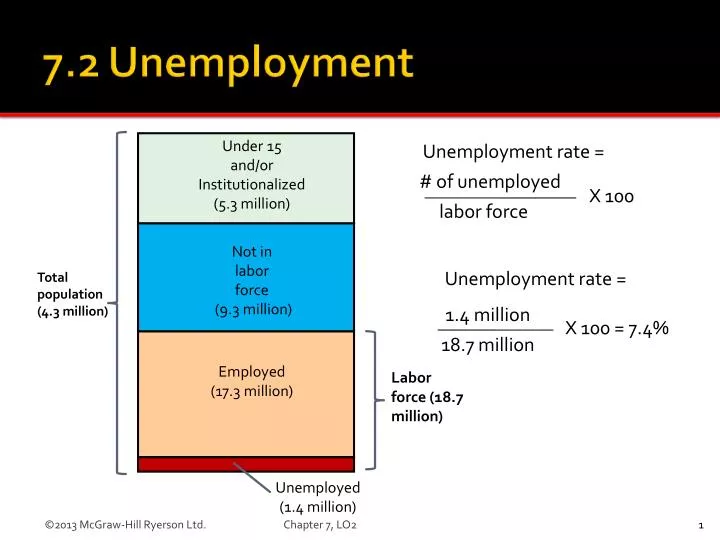
Under 15 and/or Institutionalized (5.3 million) Unemployment rate = # of unemployed labor force X 100 Not in labor force (9.3 million) Unemployment rate = 1.4 million 18.7 million Total population (4.3 million) X 100 = 7.4% Employed (17.3 million) Labor force (18.7 million) Unemployed (1.4 million) Chapter 7, LO2 LO2
How the unemployment rate is understated: • Part-Time Employment Statistics • Discouraged Workers Chapter 7, LO2
Frictional Unemployment • caused by workers voluntarily changing jobs and by temporary layoffs; unemployed workers between jobs • Structural Unemployment • caused by Changes over time in consumer demand and in technology alter the “structure” of the total demand for labour, both occupationally and geographically • Cyclical Unemployment • caused by a decline in total spending (or by insufficient aggregate demand) • Seasonal Unemployment • caused by seasonal factors Chapter 7, LO2
Natural rate of unemployment (NRU) • NOT zero unemployment • Occurs when there is no cyclical unemployment • Not automatic • Varies over time Chapter 7, LO2
GDP Gap • GDP gap = actual GDP – potential GDP • Can be negative or positive • Okun’s Law • Every 1% of cyclical unemployment creates a 2% GDP gap Chapter 7, LO2
Economic Costs of Unemployment • Given for 2009: • Unemployment rate is 8.3% • Natural rate is 6.5% • Potential GDP is $1360 billion • What is the GDP gap? • 8.3% 6.5% = 1.8% (gap in % terms) • 1.8% X 2 = 3.6% (apply Okun’s Law) • 3.6% of $1360 billion = $49 billion Chapter 7, LO2
Economic Costs of Unemployment • Unequal Burdens • Occupation • Age • Gender • Education Chapter 7, LO2
Unemployment means idleness • Increases poverty, heightens racial and ethnic tensions, and reduces hope for material advancement • Severe unemployment can lead to rapid and violent social and political change • higher unemployment linked to increases in suicide, homicide, and physical and mental illness Chapter 7, LO2